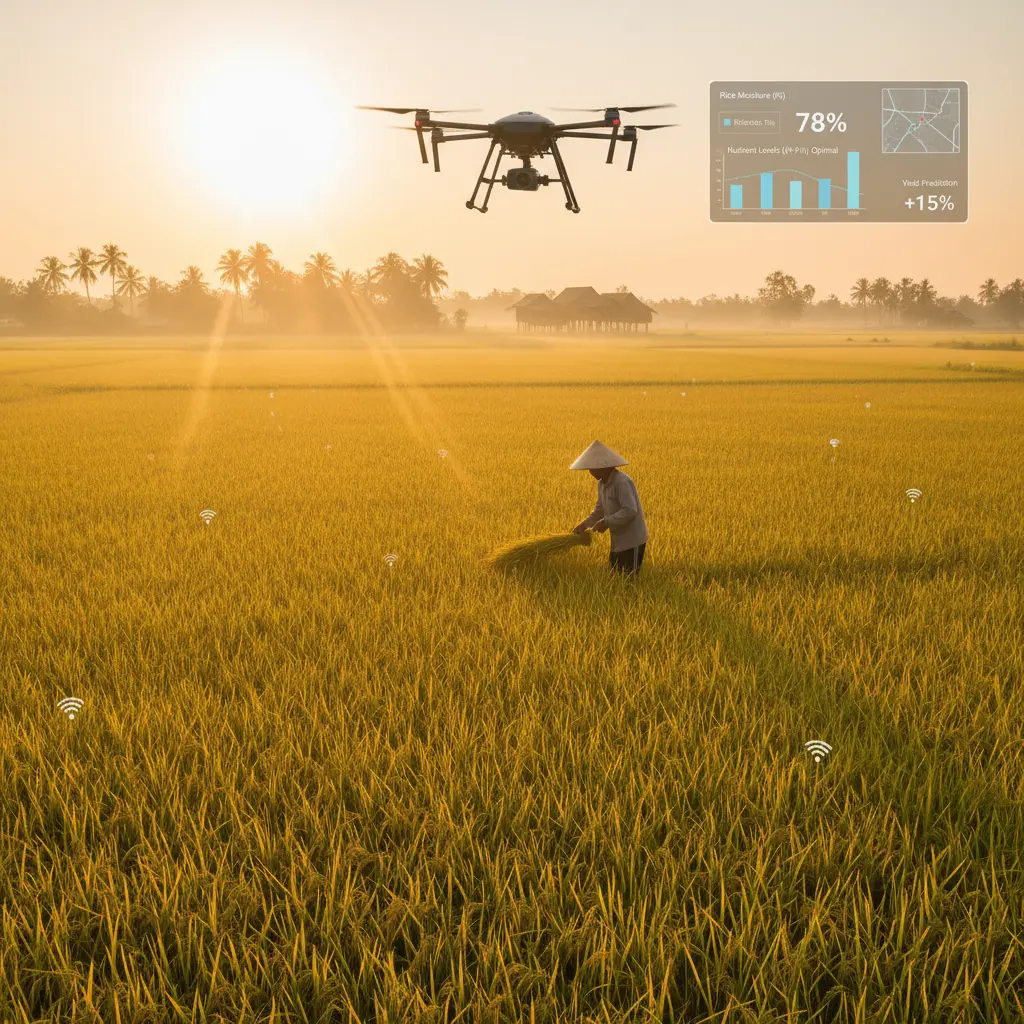
This article examines how Vietnam’s Winter-Spring rice season—responsible for 47% of annual rice production—has transformed through AI, blockchain, carbon markets, and precision agriculture by November 2025, based on government data, World Bank reports, and field research.
Why Winter-Spring Rice Matters More Than Ever
Vietnam stands as the world’s third-largest rice exporter, trailing only India and Thailand, with rice exports reaching $4.9 billion in 2023 and climbing to an estimated $5.2 billion in 20251. But behind these impressive numbers lies a more compelling story: how the Winter-Spring harvest season has evolved from traditional farming into a showcase of agricultural innovation that’s redefining what’s possible in smallholder farming.
The Winter-Spring crop—cultivated from November through April across Vietnam’s fertile Mekong Delta—isn’t just another growing season. It’s the economic backbone of Vietnamese agriculture, contributing nearly 47% of annual rice production while employing over 10 million farming households2. In 2025, this season has become ground zero for proving that traditional agriculture and modern technology aren’t competing visions—they’re complementary forces.
The Three Pillars of Winter-Spring Dominance
Annual Production Leadership
The Winter-Spring season claims over 40% of Vietnam’s total rice cultivation area and delivers 20.63 million tons of paddy annually—more than any other season3. The 2024-25 Winter-Spring cycle achieved an average yield of 68.6 quintals per hectare, representing a 2.9 quintal increase over previous years3.
This isn’t just about volume. The dry-season conditions create optimal growing environments for premium varieties like ST25 (three-time World’s Best Rice winner), Jasmine 85, and Japonica cultivars that command $820 per ton in export markets—nearly double conventional rice prices4.
Quality Premium That Buyers Pay For
Winter-Spring rice consistently outperforms Summer-Autumn and Autumn-Winter crops across every quality metric:
- Higher milling rates (less broken grain)
- Superior aroma and texture preferred by premium buyers
- Better appearance meeting export standards for Japanese and Korean markets
- Lower moisture content enabling longer storage without quality degradation
- Reduced pest and disease pressure compared to rainy-season crops
In June 2025, Vietnam’s first shipment of 500 tonnes of certified green, low-emission rice to Japan achieved the premium $820/ton price point, validating that sustainability certifications unlock differentiated pricing power4.
Water Management Advantage
The dry-season timing allows precision irrigation control that’s impossible during monsoon periods. This advantage has become transformational with the adoption of Alternate Wetting and Drying (AWD) technology, which:
- Reduces water consumption by 30-40%
- Cuts methane emissions by up to 47%
- Maintains or improves yields
- Reduces production costs by VND 500-800 per kilogram ($20-32 per ton)5
By October 2025, over 354,000 hectares across the Mekong Delta have adopted AWD practices integrated with IoT sensors and smartphone-based irrigation scheduling6.
The 2025 Technology Stack Transforming Winter-Spring Farming
Google’s Agricultural APIs: Satellite Intelligence at Field Scale
In October 2025, Google expanded its Agricultural Landscape Understanding (ALU) and Agricultural Monitoring and Event Detection (AMED) APIs to Vietnam, delivering unprecedented precision to Winter-Spring planning7:
What farmers and buyers gain:
- Individual field boundary detection with unique identifiers
- Crop-type classification with confidence scores
- Sowing and harvesting date tracking updated every 15 days
- 15 years of historical data for yield forecasting
- Remote verification for lending, insurance, and carbon credit certification
These APIs enable Winter-Spring cooperatives to prove cultivation practices to premium buyers and carbon-credit verifiers without expensive manual audits.
Carbon Credits: New Income Stream for Winter-Spring Farmers
The World Bank’s Transformative Carbon Asset Facility (TCAF) approved $33.3-40 million in carbon credit payments to Vietnamese rice farmers, with Winter-Spring cultivation receiving priority due to its scale8. Each hectare practicing low-emission methods generates approximately 2 carbon credits valued at $20 each, adding VND 960,000 ($38 USD) in pure environmental income per hectare9.
Vietnam is preparing a pilot carbon trading exchange by late 2026, creating domestic price discovery and potentially higher carbon values as supply-and-demand dynamics emerge10.
Blockchain Traceability: Premium Price Insurance
Premium Winter-Spring varieties like ST25 and Jasmine 85 face counterfeiting threats in export markets. Blockchain-based traceability platforms—Agridential, WowTrace, and FruitChain—now enable transparent farm-to-consumer tracking11:
What’s tracked on-chain:
- GPS coordinates of cultivation area
- Sowing and harvest dates
- Fertilizer and pesticide application records
- Processing facility and quality certifications
- Export destination and buyer verification
Buyers scanning QR codes at Tokyo supermarkets can verify the exact Mekong Delta farmer who grew their rice, weather conditions during growth, and certified emission reductions—unlocking the $820/ton premium pricing that traceability assures4.
Agricultural Drones: Standard Equipment by 2025
Kien Giang Province alone operates over 690 agricultural drones as of December 2024, with numbers estimated to have doubled by the 2024-25 Winter-Spring season12. Drone services provide:
- Precision seeding across 9 hectares in under 2 hours
- Variable-rate fertilizer application optimizing nutrient efficiency
- Targeted pesticide spraying reducing chemical use by 40%
- Aerial imagery for disease detection triggering early intervention
Cooperative-owned drone fleets enable smallholders to access precision agriculture without capital investment, spreading costs across 50-100 member farms.
IoT Sensors + AWD: Data-Driven Water Management
IoT-enabled AWD systems deploy soil moisture sensors, water-level monitors, and weather station data to automate irrigation scheduling. World Bank pilots showed that farmers using IoT-based AWD used 13-20% less water than manual AWD practitioners, while over 95% wanted to continue using the technology13.
Winter-Spring’s dry conditions make it the ideal proving ground for AWD, with lessons scaling to other seasons as infrastructure expands.
Economic Impact: What Changed Between 2024 and 2025
Export Value Surge
Vietnam’s rice exports reached $4.9 billion in 2023, representing an 11.9% increase year-over-year1. Preliminary 2025 data suggests exports will exceed $5.2 billion, with Winter-Spring premium varieties capturing growing shares of Japanese, Korean, and European markets14.
Farmer Income Transformation
Traditional Winter-Spring farming yielded approximately VND 50-80 million per hectare ($2,000-3,200 USD) in net profit. By 2025, technology-enabled farming delivers:
- Smart AWD + IoT systems: VND 140-160 million/ha ($5,600-6,400 USD)
- Premium certified varieties: VND 200-250 million/ha ($8,000-10,000 USD)
- Carbon credit bonus: Additional VND 960,000/ha ($38 USD) per season
Farmers like Tu Tan in Long An Province now operate 120 hectares with 30 workers (down from 200+ traditionally), achieving $4,125 per hectare profit—a transformation documented in field studies15.
Market Diversification Success
Vietnam exported rice to 150+ countries in 2024, with Winter-Spring premium varieties opening new markets1:
- China: 1.8 million tons annually (largest buyer)
- Philippines: 1.4 million tons (growing market)
- Malaysia: 800,000 tons (stable demand)
- Japan: 250,000 tons premium varieties (highest prices)
- South Korea: 180,000 tons specialty rice (certification-driven)
The first 500-tonne green-certified shipment to Japan in June 2025 signals a structural shift toward sustainability-premium markets4.
Cooperative Models: Scaling Technology Without Capital Barriers
The 2,700+ cooperatives operating across the Mekong Delta have become the critical infrastructure enabling smallholder access to Winter-Spring technology16. Successful cooperative models demonstrate:
Shared Equipment Ownership
Phuoc An Cooperative (Can Tho, 63 hectares) operates:
- 3 agricultural drones serving 80 member farms
- IoT sensor network covering all cultivation areas
- Shared processing and storage facilities
- Collective VietGAP certification reducing per-farmer costs
Members earn VND 200-300 per kilogram premium over market rates through guaranteed buyer contracts17.
Collective Certification Pathways
Individual farmers face $1,000-2,000 certification costs—prohibitive for 0.5-2 hectare smallholdings. Cooperatives achieve:
- Group certification spreading costs across 50-100 members
- Collective carbon credit verification enabling MRV at scale
- Buyer contract negotiation delivering premium pricing guarantees
- Technical training and support from agronomists and extension services
Technology Service Models
Progressive cooperatives offer drone spraying at VND 150,000 per hectare ($6 USD), IoT monitoring subscriptions, and blockchain traceability as paid services, creating new rural income streams while democratizing access.
Challenges That Persist Despite Innovation
Infrastructure Gaps in Remote Areas
While urban Mekong Delta districts have robust 4G/5G coverage, remote communes still experience:
- Unstable electricity supply disrupting IoT sensors
- Limited mobile connectivity preventing real-time alerts
- Poor road infrastructure raising drone service costs
- Insufficient cold storage near production areas
An estimated $500 million-$1 billion investment would achieve universal broadband and electricity coverage needed for full digital agriculture rollout18.
Digital Literacy and Age Barriers
Surveys across An Giang, Dong Thap, and Tay Ninh provinces show:
- 65% of farmers express willingness to adopt AI technology
- Only 35% feel confident using tools independently
- Farmers over 60 adopt at significantly slower rates
- Secondary education correlates with 3x faster adoption
The solution isn’t simpler technology—it’s sustained investment in training and technical support networks accessible to aging farming populations19.
Market Competition Intensifying
Despite Vietnam’s quality improvements, global competition remains fierce:
- India and Pakistan export rice at $350-400/ton (undercutting Vietnam’s $441/ton average)
- Thailand’s Jasmine rice commands $600-800/ton (competing in premium segment)
- Global rice prices declined 30% from 2024 to early 2025 due to supply-side pressures
Vietnam’s path forward requires continuous quality escalation and sustainability differentiation that competitors cannot easily replicate20.
Climate Threats Accelerating
Even with technology, Winter-Spring cultivation faces:
- Saltwater intrusion advancing 4 grams per liter in coastal areas (exceeding crop tolerance)
- Drought risk in 2024-25 dry season requiring early reservoir management
- Land subsidence losing approximately 500 hectares annually to erosion
- Soil degradation from intensive three-crop annual rotations despite reduced chemicals
Technology mitigates but cannot eliminate these ecological constraints21.
The Future of Winter-Spring Rice: 2026-2030 Outlook
Expansion Targets
- Current state (Oct 2025): 354,000 hectares under low-emission management
- Government target (2030): 2.5 million hectares low-emission cultivation
- Required scaling: 7x growth over 5 years
- Cooperative expansion: 1,000+ new farmer organizations needed
Income Benchmarks for Sustainable Farming
By 2030, Winter-Spring rice farming should provide:
- Small farmers (0.5-2 ha): VND 100-150 million annually ($4,000-6,000 USD)—enabling poverty escape
- Medium farmers (2-10 ha): VND 300-500 million annually ($12,000-20,000 USD)—creating middle-class livelihoods
- Large farmers (10+ ha): VND 1-2 billion annually ($40,000-80,000 USD)—viable business enterprises
These aren’t aspirational—they’re achievable with current technology and policy support22.
Technology Accessibility Goals
By 2030, all Winter-Spring farmers should access:
- Basic IoT monitoring through cooperative sensor networks
- AI crop advisory via SMS, mobile apps, and village information centers
- Drone spraying services through regional providers
- Carbon credit verification through government MRV systems
Currently available to 10-15% of farmers; scaling to 70%+ requires sustained infrastructure and training investment23.
Practical Playbook for Winter-Spring 2025-26 Season
For Smallholder Farmers
- Join or form a cooperative to access drones, sensors, and certification without bearing full capital costs
- Adopt AWD with basic sensors—even manual AWD saves 30% on water and reduces methane
- Plant premium varieties (ST25, Jasmine 85, Japonica) if you can access certification pathways
- Subscribe to provincial pest alerts and time spraying to warnings, reducing applications and costs
- Explore low-emission pilots to qualify for carbon incentives launching in 2026
For Rice Buyers and Processors
- Integrate Google ALU/AMED APIs for remote field verification and quality forecasting
- Offer premium contracts for certified low-emission and traceable rice—demand is exceeding supply
- Partner with cooperatives to co-invest in certification and shared infrastructure
- Implement blockchain traceability to protect premium brand reputation and prevent counterfeiting
- Lock in carbon credits from contracted farmers as carbon markets launch in 2026
For Policymakers and Investors
- Prioritize rural broadband and electricity reliability—every dollar returns $3-5 in productivity
- Subsidize cooperative equipment (drones, sensors) rather than individual farmer subsidies
- Streamline carbon credit MRV to reduce verification costs and accelerate farmer payments
- Establish Winter-Spring quality standards for export branding and premium positioning
- Fund training networks reaching aging farmers with hands-on technical support
Real Stories: Farmers Who Made the Leap
Case Study 1: Cooperative-Led Transformation in Can Tho
Phuoc An Agricultural Cooperative manages 63 hectares of fragrant rice under VietGAP standards, fully mechanized with blockchain traceability. Members collectively invested in:
- 3 drones providing service to 80 farms
- Complete IoT sensor coverage
- Shared processing and storage facilities
Results: Members earn VND 200-300 per kilogram premium above market rates, with guaranteed offtake contracts eliminating market uncertainty17.
Case Study 2: Tu Tan’s Tech-Driven Enterprise
Tu Tan in Long An Province operates 120 hectares with just 30 workers (down from 200+ traditionally). His operation includes:
- 5 agricultural drones
- IoT irrigation control systems
- Real-time weather and pest monitoring
- Three annual crop cycles
Annual yield: 21.5 tonnes per hectare across three seasons
Profit: VND 100 million per hectare ($4,125 USD)
Secondary income: Drone services to neighboring farmers15
Case Study 3: Premium Export Breakthrough
In June 2025, seven Vietnamese enterprises received official “Vietnam Green – Low Emission Rice” certification, shipping the first 500-tonne batch to Japan at $820 per ton—matching Thailand’s premium Hom Mali rice and double conventional Vietnamese rice prices4.
This breakthrough validated that sustainability investments unlock tangible price premiums in export markets demanding certified low-carbon products.
The Technology-Tradition Synthesis
What strikes me most about the Winter-Spring transformation isn’t the drones, sensors, or blockchain—it’s that technology hasn’t replaced traditional farming wisdom; it’s amplified it.
Farmers still respect soil health, practice crop rotation, and read weather patterns as their grandparents did. But now they supplement intuition with data, confirm hunches with sensors, and protect livelihoods with carbon income that rewards environmental stewardship.
The Winter-Spring season in 2025 represents something profound: proof that smallholder farming can be economically viable, environmentally regenerative, and technologically advanced simultaneously—if the right infrastructure, policy, and market incentives align.
This isn’t just Vietnam’s story. It’s a blueprint for rice-growing regions across Asia, Africa, and beyond facing the same climate pressures, market dynamics, and smallholder economics.
Conclusion: The Season That Changed Everything
The 2024-25 Winter-Spring harvest will be remembered as the season when Vietnamese agriculture stopped choosing between tradition and innovation—and proved both could thrive together.
With 354,000 hectares already transformed, $40 million in carbon payments flowing to farmers, premium export prices validated, and cooperatives scaling solutions across the Delta, the path forward is clear.
The question isn’t whether technology works in smallholder agriculture—it’s how fast we can scale infrastructure, training, and market access to reach the remaining 85% of farmers still farming without these tools.
The Winter-Spring season of 2025-26 begins in November. Every day of delay is a lost opportunity for farmers to benefit from innovations that are already proven, profitable, and ready to scale.
Connect and Collaborate
Share your Winter-Spring farming experiences, technology insights, or buyer perspectives in the comments below. Let’s learn from each other and accelerate this transformation together.
- 📧 Email: karthicksivaraj@live.com
- 🔗 LinkedIn: linkedin.com/in/karthicksivaraj
If you found this article valuable, share it with your network. The more farmers, buyers, and policymakers understand what’s possible, the faster we can scale solutions that work.
References
VietnamPlus, “Vietnam’s rice export value up 11.9 percent in 2023,” https://en.vietnamplus.vn/vietnams-rice-export-value-up-119-percent-in-2023/197823.vnp (2024) ↩︎ ↩︎ ↩︎
Wikipedia, “Rice production in Vietnam,” https://en.wikipedia.org/wiki/Rice_production_in_Vietnam (2024) ↩︎
General Statistics Office of Vietnam, “Vietnam’s rice production in 2021-2024,” https://www.gso.gov.vn/en/ (2024) ↩︎ ↩︎
Vietnam News Agency, “Vietnam transforms rice industry as low-emission rice gains global traction,” https://english.vov.vn/en/economy/vietnam-transforms-rice-industry-as-its-low-emission-post1206945.vov (2025) ↩︎ ↩︎ ↩︎ ↩︎ ↩︎
AgTech Navigator, “Vietnam’s low-emission rice project cuts costs and carbon,” https://www.agtechnavigator.com/Article/2025/07/23/vietnams-low-emission-rice-project (2025) ↩︎
Vietnam Digital Agriculture Platform Ecosystem (VDAPES), https://rynanagriculture.com/news-blogs/digital-agriculture-platform-ecosystem (2025) ↩︎
VOVWorld, “Google expands AI agriculture models to Vietnam,” https://vovworld.vn/en-US/digital-life/google-expands-india-tested-ai-agriculture-models-to-vietnam (2025) ↩︎
Carbon Herald, “Vietnam Farmers To Receive $40M In Carbon Credit Payments,” https://carbonherald.com/vietnam-farmers-to-receive-40m-in-carbon-credit-payments (2024) ↩︎
Vietnam News, “Nearly 1,000 billion VND for rice carbon credits,” https://www.vietnam.vn/en/se-co-gan-1-000-ty-dong-chi-tra-tien-tin-chi-carbon-lua (2024) ↩︎
Hanoi Times, “Vietnam to launch pilot carbon trading exchange by late 2026,” https://hanoitimes.vn/vietnam-to-launch-pilot-carbon-trading-exchange-by-late-2026 (2025) ↩︎
Vietnam Net, “Blockchain seen as key to enhancing origin traceability,” https://vietnamnet.vn/en/blockchain-seen-as-key-to-enhancing-origin-traceability (2025) ↩︎
Vietnam News, “Use of agricultural drones on the rise in the Mekong Delta,” https://vietnamnews.vn/society/1688198/use-of-agricultural-drones-on-the-rise (2024) ↩︎
World Bank, “Precision agriculture for smallholder farmers in Vietnam,” https://blogs.worldbank.org/en/eastasiapacific/precision-agriculture-smallholder-farmers-vietnam (2020) ↩︎
Source Vietnam, “How Vietnam’s Rice Exports Are Changing in 2025,” https://sourcevietnam.com/blog/how-vietnams-rice-exports-are-changing-in-2025 (2025) ↩︎
CT Group, “The Mekong Delta Embraces Smart Agriculture,” https://ctgroupvietnam.com/en/the-mekong-delta-embraces-smart-agriculture/ (2025) ↩︎ ↩︎
Vietnam News, “Cooperatives lead the way in Mekong Delta’s sustainable rice project,” https://vietnamnews.vn/economy/1725029/cooperatives-lead-the-way (2025) ↩︎
ACIAR, “How Mekong Delta farmers gained access to premium export markets,” https://www.aciar.gov.au/media-search/blogs/mekong-delta-farmers-premium-export-markets (2022) ↩︎ ↩︎
Hungnhongroup, “The Prospects for IoT Development in Vietnamese Agriculture,” https://hungnhongroup.com.vn/en/trien-vong-phat-trien-iot-trong-nong-nghiep-tai-viet-nam/ (2025) ↩︎
IJRPR, “Attitudes of Vietnamese Farmers Towards the Application of Drones,” https://ijrpr.com/uploads/V5ISSUE7/IJRPR31605.pdf (2024) ↩︎
VCCI, “Rising Competition, Falling Prices Challenges for Vietnamese Rice,” https://en.vcci.com.vn/rising-competition-falling-prices-challenges-for-vietnamese-rice (2025) ↩︎
FAO, “For Mekong Delta farmers, diversification is the key to climate resilience,” https://www.fao.org/family-farming/detail/en/c/1638024/ (2022) ↩︎
TMA Solutions, “The Future of Smart Farming: How AI Helps Vietnamese Farmers,” https://www.tmasolutions.com/insights/the-future-of-smart-farming (2025) ↩︎
Digital Tools Offer Economic Boost To Vietnamese Farmers, https://www.global-agriculture.com/ag-tech-research-news/digital-tools-offer-economic-boost-to-vietnamese-farmers/ (2025) ↩︎
💬 Join the Conversation