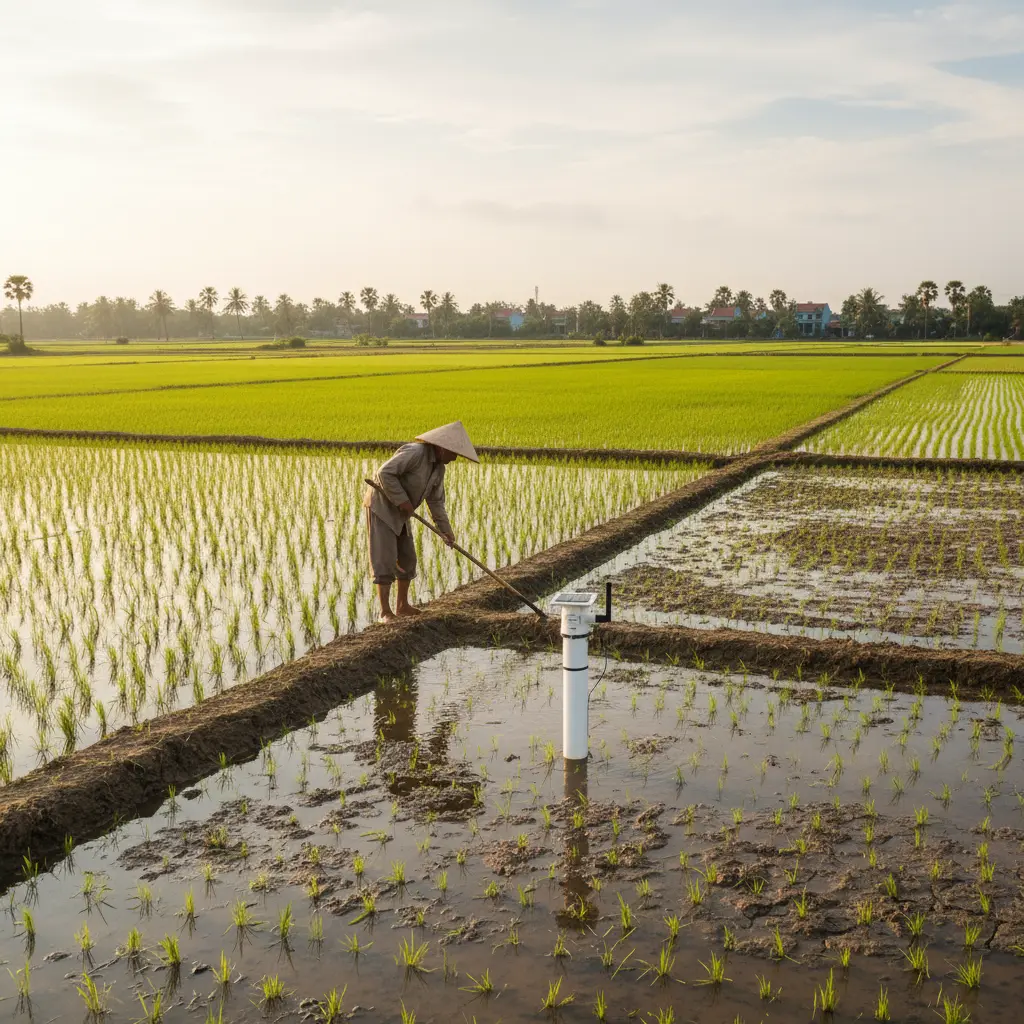
This article examines Vietnam’s comprehensive strategy to transform rice cultivation—historically a major methane emitter—into a carbon-credit generating, climate-resilient agricultural system by 2030, based on government policy documents, World Bank programs, and field implementation data through November 2025.
Why Vietnam’s Rice Matters for Global Climate Goals
Rice cultivation accounts for 10-12% of global methane emissions, making it a critical target for climate action1. Vietnam, as the world’s third-largest rice exporter producing 43.88 million tons annually, faces a dual imperative: maintain food security and export competitiveness while dramatically reducing greenhouse gas emissions2.
The Mekong Delta alone—Vietnam’s rice heartland—produces over 50% of national output and employs 10 million farming households3. Yet this productivity comes at an environmental cost: agriculture contributes 19% of Vietnam’s total greenhouse gas emissions, with rice cultivation responsible for 48% of agricultural emissions4.
In 2025, Vietnam is proving that this trade-off is false. Through Alternate Wetting and Drying (AWD) irrigation, integrated rice-aquaculture systems, rice straw biogas conversion, and carbon credit mechanisms, the country is simultaneously:
- Reducing methane emissions by up to 47% per hectare
- Maintaining or improving rice yields
- Generating $33.3-40 million in carbon credit payments for farmers
- Expanding low-emission cultivation to 2.5 million hectares by 2030
- Building climate resilience against saltwater intrusion and drought
This isn’t theory—it’s operational reality backed by Verra-certified carbon credits, World Bank financing, and farmer adoption at scale.
The Climate Challenge: Understanding Rice’s Carbon Footprint
Methane: Rice’s Invisible Emissions Problem
Traditional flooded rice cultivation creates anaerobic (oxygen-free) soil conditions ideal for methane-producing microbes5. When paddies remain continuously flooded for 90-120 days per growing season, these microbes convert organic matter into methane (CH₄)—a greenhouse gas 28 times more potent than CO₂ over a 100-year period1.
The emission math:
- 1 hectare of continuously flooded rice emits approximately 300-500 kg of methane per growing season5
- With 3 crop cycles annually in the Mekong Delta, this compounds to 900-1,500 kg CH₄/hectare/year
- Converted to CO₂ equivalent: 25.2-42 tonnes CO₂e per hectare annually
For Vietnam’s 7 million hectares of rice paddies, traditional practices generate an estimated 176-294 million tonnes CO₂e annually—rivaling the emissions of mid-sized industrialized nations4.
Nitrous Oxide: The Fertilizer Problem
Over-application of synthetic nitrogen fertilizers—common practice to boost yields—generates nitrous oxide (N₂O) emissions, a greenhouse gas 265 times more potent than CO₂4. Vietnamese rice farmers historically apply 150-250 kg N/hectare—nearly double optimal rates—contributing to:
- 15.3% of agricultural emissions from excessive fertilizer use4
- Nutrient runoff contaminating waterways
- Soil acidification reducing long-term productivity
- Financial waste on unnecessary inputs
Straw Burning: The Visible Emissions
After harvest, farmers traditionally burn 20-30 million tons of rice straw annually to quickly clear fields for the next planting6. This practice releases:
- Particulate matter causing severe air pollution
- Black carbon accelerating global warming
- CO₂, methane, and nitrous oxide from incomplete combustion
- Loss of organic matter that could rebuild soil health
In October 2025, Vietnam reported that circular economy approaches to rice straw are still struggling to scale despite proven technologies for biogas, animal feed, and mushroom cultivation7.
The 2025 Policy Framework: Vietnam’s Net Zero Roadmap
National Commitments and Targets
At COP26 in Glasgow, Vietnam joined the Global Methane Pledge, committing to 30% methane reduction by 2030 compared to 2020 baselines8. The agricultural sector received specific mandates:
Phase 1 (2021-2025):
- 13.34% methane reduction (equivalent to 96.4 million tons CO₂e)
- Rice and crop cultivation: 42.2 million tons CO₂e reduction target8
Phase 2 (2026-2030):
- 30% total methane reduction across all agricultural sub-sectors
- 2.5 million hectares under certified low-emission cultivation4
- 15% total greenhouse gas reduction in crop production by 2035 (vs. 2020)9
Phase 3 (2030-2050):
- Complete Net Zero transition for agriculture
- Low-emission label mandatory for export rice
- National emissions database tracking crop, region, and technique-specific impacts9
The One Million Hectares Program: Flagship Initiative
Launched in 2020 and scaled dramatically by 2025, the One Million Hectares of High-Quality, Low-Emission Rice Project focuses on the Mekong Delta. By October 2025, the program has achieved:
- 354,000 hectares under AWD and low-emission management (35% of 1M target)10
- 116,000 hectares Verra-certified for carbon credit issuance11
- 590,682 tonnes CO₂e annual emission reductions verified11
- 24 million tonnes CO₂e projected reductions through 203211
Critically, An Giang Province became the first to receive Verra Standard certification in June 2025, unlocking international carbon credit markets and validating methodologies for nationwide scaling11.
Carbon Credit Mechanisms Operational
The World Bank’s Transformative Carbon Asset Facility (TCAF) approved $33.3-40 million in Emission Reduction Payment Agreements (ERPAs) for Vietnamese rice farmers adopting AWD and low-emission practices12. This creates a direct financial incentive structure:
- Each hectare practicing AWD generates approximately 2 carbon credits annually
- $20 per credit market price (Verra-verified voluntary market)
- VND 960,000 ($38 USD) additional income per hectare per season
- Projected $581 million total farmer payments by 2030 as program scales
Vietnam is preparing a pilot domestic carbon trading exchange by late 2026, enabling price discovery and potentially higher carbon values as domestic demand emerges from corporate net-zero commitments[^13].
AWD Irrigation: The Core Technology
How Alternate Wetting and Drying Works
AWD replaces continuous flooding with cycles of controlled drying and re-flooding[^14]:
Traditional flooding:
- Fields remain 5-10 cm deep in water throughout 90-120 day growing season
- Anaerobic conditions persist, maximizing methane production
- Water consumption: 1,500-2,000 mm per crop cycle
AWD practice:
- Fields flooded during critical growth stages (transplanting, flowering, grain filling)
- Water drained allowing soil to dry to 15 cm below surface between critical stages
- Aerobic conditions interrupt methane production
- Water consumption: 1,000-1,400 mm per crop cycle (30-40% reduction)[^14]
The irrigation schedule:
- Week 0-2 (transplanting): Continuous flooding 5 cm depth
- Week 3-4: Drain and allow soil to dry to 15 cm below surface
- Week 5-8: Flood to 5 cm for tillering stage
- Week 9-10: Drain again to 15 cm below surface
- Week 11-14 (flowering/grain filling): Flood to 5 cm
- Week 15-16: Final drain before harvest
Measured Environmental Impact
Field trials across An Giang, Dong Thap, and Can Tho provinces demonstrate AWD’s effectiveness11[^14]:
| Metric | Traditional Flooding | AWD Practice | Improvement |
|---|---|---|---|
| Methane emissions | 300-500 kg CH₄/ha | 150-265 kg CH₄/ha | 47% reduction |
| Water use | 1,500-2,000 mm | 1,000-1,400 mm | 30-40% reduction |
| Rice yield | 6.0 tonnes/ha | 6.2 tonnes/ha | 3% increase |
| Production cost | VND 45M/ha | VND 42M/ha | VND 3M savings |
| Carbon credits | 0 | 2 credits/ha | +VND 960K income |
The yield paradox: Farmers initially feared AWD would reduce productivity. Field data shows AWD maintains or slightly improves yields because:
- Improved soil aeration enhances root development
- Reduced methane toxicity to roots
- More efficient nutrient uptake
- Lower disease pressure (many rice diseases thrive in flooded conditions)
IoT-Enabled AWD: Technology Integration
Manual AWD requires farmers to monitor soil moisture and make irrigation decisions—labor-intensive and prone to error. IoT-enabled AWD systems deployed across 50,000+ hectares by 2025 automate the process[^15]:
Hardware components:
- Soil moisture sensors at 15 cm and 30 cm depths
- Water level sensors in field and irrigation canals
- Weather stations providing rainfall and evapotranspiration data
- Mobile connectivity (4G/5G) transmitting data to cloud platforms
Software features:
- Automated irrigation scheduling based on crop stage and soil moisture
- SMS and app alerts notifying farmers when to flood or drain fields
- Yield forecasting based on growth conditions
- Carbon credit verification through automated MRV (Measurement, Reporting, Verification)
World Bank studies show farmers using IoT-based AWD used 13-20% less water than those practicing manual AWD, with over 95% satisfaction rates[^15].
Integrated Rice-Aquaculture: Diversification for Resilience
The Rice-Shrimp Model
In coastal provinces facing saltwater intrusion, the rice-shrimp rotational farming model has become the primary climate adaptation strategy[^16]. By 2025, approximately 220,000-250,000 hectares operate under this system across Kien Giang, Ca Mau, Bac Lieu, and Tra Vinh provinces[^17].
The annual cycle:
- Rainy season (June-November): Freshwater available, grow 1 crop of rice (4-4.5 tonnes/hectare)
- Dry season (December-May): Saltwater intrusion period, raise black tiger shrimp or giant freshwater prawns (300-500 kg/hectare)
Environmental benefits:
- Reduced methane emissions (50% less time in flooded rice conditions)
- Natural salinity management (shrimp ponds leach salt during rainy season)
- Minimal chemical inputs (shrimp intolerant to pesticides, forcing organic practices)
- Biodiversity enhancement (aquatic ecosystems support fish, crabs, other species)
Economic advantage:
- Dual income streams reducing market risk
- Rice income: VND 80-120 million/ha
- Shrimp income: VND 150-200 million/ha
- Total: VND 230-320 million/ha ($9,200-12,800 USD)—3-4x conventional rice monoculture
At the Vietnam Net Zero Forum 2025, rice-shrimp farming was highlighted as one of three standout community-driven, nature-based climate solutions[^18].
The Rice-Fish Model
In freshwater areas, rice-fish integration combines rice cultivation with fish species tolerant to shallow water (common carp, tilapia, snakehead fish)[^17]. Fish:
- Consume pests reducing pesticide needs
- Provide natural fertilization through excreta
- Improve water quality through biological filtering
- Generate additional income (100-200 kg fish/hectare worth VND 15-30 million)
Studies indicate integrated rice-fish systems can reduce fertilizer application by 30% and pesticide use by 40% compared to rice monoculture while maintaining comparable rice yields[^17].
Rice Straw: From Waste to Wealth
The Circular Economy Challenge
Vietnam generates 20-30 million tons of rice straw annually6. Historically, 60-70% was burned in fields, creating severe air pollution and GHG emissions. The remaining 30-40% was used as low-quality animal feed or left to decompose.
In 2025, Vietnam is scaling three primary valorization pathways:
1. Biogas Production
The BioRist pilot project (2016-2019) demonstrated technical feasibility of co-fermenting rice straw with cow manure in biogas digesters[^19]. By 2025, commercial biogas operations are emerging:
Technology:
- Anaerobic digestion of rice straw + 30% livestock manure
- Biogas output: 200-250 m³ per ton of straw
- Energy value: Equivalent to 4,000-5,000 MJ (replacing LPG or diesel)
- Digestate byproduct: High-quality organic fertilizer
Economics:
- Straw purchase price: VND 800-1,200 per kg ($0.032-0.048 USD/kg)
- Farmer income: VND 400,000-600,000 per hectare per season selling straw[^20]
- Biogas plant revenue: Energy sales + organic fertilizer sales
- GHG reduction: Prevents methane from open burning + displaces fossil fuel use
Scaling barriers: Logistics of collecting, transporting, and storing bulky straw remains challenging. Most viable models involve cooperative-owned mini-digesters serving 50-100 farms within 5 km radius7.
2. Mushroom Cultivation
Rice straw serves as substrate for oyster and straw mushroom cultivation, generating:
- 10-15 kg fresh mushrooms per 100 kg straw
- VND 30,000-50,000 per kg mushroom wholesale price
- VND 3-7.5 million revenue per ton of straw processed
- Spent substrate becomes high-quality compost after mushroom harvest
Mushroom cultivation is labor-intensive but well-suited to smallholder farmers seeking income diversification.
3. Animal Feed and Composting
When treated with urea or ammonia, rice straw digestibility improves significantly, making it viable cattle and buffalo feed. This approach is widespread in northern Vietnam’s livestock regions.
Alternatively, composting rice straw with livestock manure generates nitrogen-rich organic fertilizer, closing the nutrient loop and reducing synthetic fertilizer dependency.
September 2025 field day: IRRI demonstrated straw management practices to over 200 Mekong Delta farmers, with participants reporting willingness to sell straw if collection logistics are solved[^20].
Combating Saltwater Intrusion: Adaptation at Scale
The Escalating Crisis
Saltwater intrusion has intensified across the Mekong Delta due to:
- Upstream flow reduction: Dry-season river discharge now only 60-75% of historical average[^21]
- Sea level rise: Approximately 3-4 mm annually in coastal provinces
- Land subsidence: Excessive groundwater extraction causing 1-2 cm annual sinking
- Climate change: El Niño events reducing rainfall and extending dry seasons
2025 situation: Between late February and mid-March 2025, saltwater penetrated 65-70 km inland in several river estuaries—affecting approximately 1.77 million hectares of agricultural land[^22].
Salinity thresholds:
- Rice tolerance: Maximum 4 grams/liter during vegetative stage, 2 g/L during flowering
- 2025 observed levels: 4-8 grams/liter in coastal areas during peak intrusion[^21]
Government Response and Adaptation Strategies
The Prime Minister’s Directive (February 17, 2025) mandated urgent multi-pronged responses[^22]:
Infrastructure investments:
- Sluice gates and tidal barriers preventing saltwater backflow into canals
- Freshwater reservoirs storing rainy-season water for dry-season irrigation
- Canal dredging increasing storage capacity
Agricultural adjustments:
- Shifted planting calendars starting Winter-Spring crop earlier (late October vs. mid-November)
- Salt-tolerant rice varieties (OM5451, OM9582, SHPT3) planted in high-risk zones
- Rice-shrimp conversion in areas where salinity exceeds rice tolerance consistently
Early warning systems:
- Provincial salt intrusion forecasting issuing 7-14 day alerts via SMS
- Real-time salinity monitoring at 50+ stations along major rivers
- Commune-level response plans pre-positioning pumps and irrigation equipment
Deputy Minister assessment (October 2025): “With proactive measures in place, the Mekong Delta is fully prepared to completely mitigate damage from saltwater intrusion this season”[^22].
Technology Solutions: Digital Platforms for Low-Carbon Farming
Farmer-Facing Mobile Applications
Multiple digital platforms have emerged to support low-emission farming adoption:
Core features:
- Farm and field management: GPS-based boundary mapping, crop calendar tracking
- AWD irrigation scheduling: Automated alerts for flooding and draining based on sensors or manual input
- Carbon footprint calculation: Real-time tracking of emissions from fertilizer, irrigation, and fuel use
- Personalized recommendations: AI-driven advice on optimal input timing and quantities
- Marketplace integration: Direct access to certified inputs, carbon credit buyers, and premium rice contracts
- Knowledge sharing: Forums connecting farmers with extension officers and agronomists
Government Data Infrastructure
Vietnam’s national emissions database (target completion 2026) will integrate:
- Field-level cultivation records from 1M+ farms
- Remote sensing data from satellite imagery (Google ALU/AMED APIs)
- IoT sensor streams from AWD systems
- Carbon credit verification linked to Verra and Gold Standard registries
- Supply chain traceability via blockchain for premium export markets
This infrastructure enables Measurement, Reporting, and Verification (MRV) at scale—essential for carbon credit issuance and low-emission label certification9.
Economic Impact: Who Benefits from Low-Carbon Transition?
Farmer Income Analysis
| Farming System | Annual Income (VND M/ha) | Annual Income (USD/ha) | Notes |
|---|---|---|---|
| Traditional rice monoculture | 50-80 | $2,000-3,200 | Baseline |
| AWD-enabled rice (no carbon credits) | 100-130 | $4,000-5,200 | Input cost savings |
| AWD + carbon credits | 105-135 | $4,200-5,400 | Added VND 4-5M annually |
| Rice-shrimp integrated | 230-320 | $9,200-12,800 | Dual income streams |
| Premium low-emission certified | 200-280 | $8,000-11,200 | Export premium pricing |
Key insight: Low-carbon farming is more profitable than conventional methods even before carbon credits, primarily due to:
- 30-40% water savings reducing pumping costs
- 15-20% fertilizer reduction through precision application
- Lower pesticide use (healthier soil reduces disease pressure)
- Stable or improved yields from better root development
Carbon credits and premium pricing are bonus income, not the sole economic justification.
Carbon Credit Revenue Projections
Current state (2025):
- 116,000 hectares Verra-certified11
- 590,682 tonnes CO₂e annual reductions verified11
- $20 per credit market price
- $11.8 million farmer payments in 2025
- Approximately $102 per hectare for certified farms
2030 projection:
- 2.5 million hectares low-emission cultivation4
- 12.75 million tonnes CO₂e annual reductions (assuming similar rates)
- $255 million annual carbon credit revenue
- $102 per hectare distributed to farmers
- Cumulative $1+ billion farmer payments 2025-2030
This revenue flow provides working capital for technology adoption, reducing dependency on high-interest agricultural loans.
Challenges and Barriers to Scaling
Infrastructure Gaps
Water control systems: AWD requires field-level water control—ability to flood and drain individual paddies. Many Mekong Delta fields lack:
- Bund levees high enough to hold water independently
- Inlet/outlet gates controlling water flow
- Drainage canals evacuating water quickly during drain cycles
Estimated investment: VND 15-25 million per hectare ($600-1,000 USD) for basic infrastructure upgrades[^23]. For 2.5 million target hectares, this represents $1.5-2.5 billion total investment needed.
Current funding: World Bank, ADB, and government subsidies cover approximately 40% of costs, with farmers bearing remainder. Cooperative models spread costs across members.
Digital Literacy and Technology Access
Surveys show 65% farmer willingness to adopt IoT-AWD systems, but only 35% confidence in independent operation[^23]. Barriers include:
- Aging farmer population (average age 55+) with limited smartphone proficiency
- Inconsistent rural connectivity (some communes still on 2G networks)
- Language barriers (ethnic minority farmers speak limited Vietnamese)
- Maintenance challenges (sensor calibration, battery replacement)
Solution pathway: Cooperative-owned systems with trained technicians managing equipment on behalf of 50-100 member farms, rather than expecting every farmer to operate technology independently.
Straw Collection Logistics
While biogas, mushroom, and composting technologies are proven, collecting straw from millions of dispersed smallholder farms remains economically marginal. Challenges:
- Low bulk density (straw is 80% air, expensive to transport)
- Short collection window (7-10 days between harvest and next planting)
- Labor scarcity (young workers migrate to cities, fewer hands for collection)
- Storage requirements (straw degrades if not dried and stored properly)
Emerging solution: Mobile baling and pelletizing equipment that travels farm-to-farm, compressing straw immediately at harvest for efficient transport to biogas plants7.
Market Access for Low-Emission Rice
While premium export markets (Japan, Korea, EU) pay $820/ton for certified low-emission rice (vs. $441/ton conventional)[^24], accessing these markets requires:
- Verra or Gold Standard certification ($50,000-100,000 per cooperative)
- Blockchain traceability infrastructure ($20,000-50,000 implementation)
- Quality consistency across 1,000+ hectare lots
- Export compliance (phytosanitary, pesticide residue limits, packaging standards)
Most smallholder farmers cannot afford these investments individually. Cooperative-led certification and contract farming arrangements with exporters are bridging this gap.
Policy Recommendations: Accelerating the Transition
1. Scale Infrastructure Investment
Target: Upgrade water control infrastructure on 500,000 hectares annually to reach 2.5M by 2030
Funding model:
- Government subsidy: 50% of costs (approximately $750M total investment)
- Carbon credit pre-financing: 30% (verified carbon credits sold forward to corporate buyers)
- Farmer contribution: 20% (spread across 3-5 years through cooperative savings)
2. Establish Cooperative Service Networks
Target: Form 1,000+ new farmer cooperatives managing shared AWD equipment and certification
Support needed:
- Capacity building: Train 5,000 cooperative managers in AWD technology and carbon credit verification
- Equipment subsidies: Provide 60% subsidies for IoT sensors, drones, and weather stations
- Technical extension: Deploy 2,000 agronomists to provide hands-on AWD training
3. Streamline Carbon Credit Verification
Target: Reduce MRV costs from $15-20/hectare to under $5/hectare through automation
Technology pathway:
- Satellite-based monitoring: Google ALU/AMED APIs providing remote field verification
- Automated data collection: IoT sensors feeding directly to carbon registries
- Blockchain-based verification: Immutable records reducing audit requirements
- Batch certification: Process 10,000+ hectares simultaneously vs. individual farm audits
4. Expand Rice Straw Valorization
Target: Eliminate rice straw burning by valorizing 80% of annual straw production by 2030
Support mechanisms:
- Subsidize mobile baling equipment: 50 units per province
- Guarantee minimum purchase prices: VND 1,000/kg for delivered straw
- Tax incentives: Biogas plants receive 5-year corporate tax exemption
- Public procurement: Government agencies prioritize organic fertilizer from straw digestate
5. Climate Adaptation Financing
Target: Build saltwater intrusion resilience infrastructure protecting 1 million hectares
Priority investments:
- 100 new tidal barriers across coastal provinces
- 500,000 cubic meter additional freshwater reservoir capacity
- 1,000 km canal dredging for increased storage
- 50,000 hectares converted to salt-tolerant varieties or rice-shrimp systems
Funding: Leverage Green Climate Fund, World Bank, and ADB climate adaptation finance (concessional loans and grants).
Success Stories: Farmers Leading the Way
Case Study 1: An Giang Province Carbon Credit Pioneer
An Giang Province became Vietnam’s first Verra-certified low-emission rice region in June 2025, covering 116,000 hectares practicing strict AWD protocols11.
Results (first crediting period):
- 590,682 tonnes CO₂e annual emission reductions
- $11.8 million carbon credit revenue (2025)
- $102 per hectare average farmer payment
- 24 million tonnes CO₂e projected reductions through 2032
What made it work:
- Provincial government commitment: Mandated AWD training for all extension officers
- Cooperative structure: 200+ cooperatives coordinating 50,000+ member farms
- IoT infrastructure: 30,000+ hectares equipped with automated sensors
- Export contracts: Pre-arranged buyers paying premium for certified rice
Farmer testimonial (Mr. Nguyen Van Hai, 8 hectares AWD-certified):
“Initially I worried AWD would reduce my harvest. After two seasons, my yield increased 5% and my water costs dropped 40%. The carbon credit payment of VND 800,000 per hectare is pure profit—like finding money I didn’t know existed.”
Case Study 2: Hanoi’s Suburban AWD Expansion
While An Giang focuses on Mekong Delta rice, Hanoi’s suburban districts are piloting AWD in Red River Delta paddies. Faeger Vietnam Co., Ltd. implemented trials in Quoc Oai and Ung Hoa districts (March-June 2025)[^25].
2025-2030 roadmap:
- 2025: Finalize data framework and comprehensive assessment (200 hectares)
- 2026: Roll out to 200 hectares with full MRV systems
- 2027-2030: Expand to 50,000 hectares across suburban Hanoi
- Target: Register carbon credits and connect to domestic/international financing
Innovation: Hanoi is testing urban-rural carbon offset markets, where city corporations purchase carbon credits from suburban rice farmers, creating direct financial flows.
Case Study 3: Rice Straw to Biogas Transformation
In Can Tho City, the BioRist pilot biogas plant demonstrated commercial viability of rice straw valorization[^19]:
System specs:
- Capacity: 5 tons rice straw + 1.5 tons cow manure daily
- Biogas production: 1,000-1,250 m³ per day
- Energy output: Equivalent to 150-190 liters diesel/day
- Digestate production: 4 tons organic fertilizer daily
Economics:
- Revenue (biogas sales): VND 12-15 million/day
- Revenue (fertilizer sales): VND 8-10 million/day
- Total revenue: VND 600-750 million/month ($24,000-30,000 USD)
- Operating costs: VND 400 million/month
- Net profit: VND 200-350 million/month ($8,000-14,000 USD)
- Payback period: 24-30 months
Farmer impact: 200 nearby farms now sell straw instead of burning, earning VND 400,000-600,000 per hectare per season while eliminating air pollution[^20].
The 2030 Vision: What Success Looks Like
By 2030, if current scaling trajectories continue, Vietnam’s low-carbon rice sector will achieve:
Environmental outcomes:
- 30% methane reduction from 2020 baseline (national target achieved)
- 2.5 million hectares under certified low-emission management
- 13 million tonnes CO₂e annual reductions (equivalent to removing 2.8 million cars)
- 80% rice straw valorization rate (vs. 30% in 2024)
- Zero open burning in Mekong Delta provinces
Economic outcomes:
- $255 million annual carbon credit revenue flowing to farmers
- Average farmer income increase of 40-60% compared to 2024
- $820/ton premium export prices for certified rice (vs. $441/ton conventional)
- $2+ billion cumulative farmer income gains from low-carbon transition
Social outcomes:
- Climate resilience enabling farming continuity despite saltwater intrusion
- Youth employment in agritech, carbon verification, and biogas operations
- Knowledge networks connecting 1M+ farmers via digital platforms
- International recognition as global leader in climate-positive agriculture
Policy outcomes:
- Domestic carbon market operational with transparent price discovery
- Low-emission label mandatory for export rice, premium branding established
- ASEAN leadership in agricultural emissions reduction (model for Thailand, Indonesia, Philippines)
- Contribution to Net Zero 2050 goal with agriculture as net carbon sink
Conclusion: From Climate Burden to Climate Solution
In 2024, Vietnamese rice farming was primarily discussed as an emissions problem—a major methane source requiring mitigation. By 2025, the narrative has shifted: rice farming is becoming a climate solution—a sector demonstrating that economic prosperity, food security, and environmental regeneration can advance simultaneously.
The Alternate Wetting and Drying revolution proves that smallholder farmers don’t need to sacrifice livelihoods for climate action. AWD reduces emissions by 47%, cuts costs by 15-20%, maintains yields, and generates carbon credit income—a rare win across every dimension.
The rice-shrimp integration model shows that climate adaptation (responding to saltwater intrusion) can be economically transformative—tripling incomes while reducing net emissions and enhancing biodiversity.
The rice straw valorization pathway demonstrates circular economy principles at scale—converting agricultural waste into biogas energy and organic fertilizer, creating new rural income streams while preventing air pollution.
Vietnam’s journey from 19% agricultural emissions in 2020 toward Net Zero by 2050 won’t be easy. Challenges remain: infrastructure investment needs are substantial, farmer training must scale 10x, straw collection logistics remain economically marginal, and saltwater intrusion continues accelerating.
But the policy framework is operational, the technology is proven, the financing mechanisms exist, and most critically—farmers are adopting at scale when proper support is provided.
The question is no longer whether low-carbon rice farming works. The question is how fast we can scale infrastructure, training, and market access to reach the remaining 85% of rice farmers still using traditional methods.
Every season of delay represents:
- Lost farmer income from carbon credits and premium pricing
- Continued methane emissions exacerbating climate change
- Missed export opportunities as buyers increasingly demand certified low-emission products
- Reduced climate resilience as saltwater intrusion and drought intensify
The technology revolution has arrived. The policy support is in place. The market incentives are clear.
Now is the moment to scale.
Take Action: How You Can Contribute
For farmers in Vietnam’s rice-growing regions:
- Contact your provincial Department of Agriculture about AWD training programs
- Join or form a cooperative to access shared equipment and certification
- Attend field days and extension programs on low-emission practices
- Explore rice-shrimp conversion if you face recurring saltwater intrusion
- Register fields for carbon credit verification through government programs
For agricultural businesses and exporters:
- Offer premium contracts for Verra-certified low-emission rice
- Co-invest in cooperative infrastructure (IoT systems, processing facilities)
- Implement blockchain traceability to protect premium brand positioning
- Partner with carbon credit buyers to pre-finance farmer adoption
- Develop export channels to Japan, Korea, EU markets demanding certified products
For policymakers and development partners:
- Prioritize infrastructure investment in water control systems (essential for AWD)
- Subsidize cooperative equipment (drones, sensors, biogas digesters)
- Streamline carbon credit MRV through satellite and IoT automation
- Guarantee straw purchase prices to incentivize collection over burning
- Fund climate adaptation (tidal barriers, reservoirs, salt-tolerant varieties)
For researchers and technologists:
- Develop lower-cost IoT sensors suitable for tropical, high-humidity conditions
- Improve satellite-based MRV reducing ground verification requirements
- Design mobile straw processing equipment solving collection logistics
- Create farmer-friendly mobile apps with multilingual support
- Study rice-aquaculture emissions to quantify GHG benefits rigorously
Connect and Collaborate
What’s your experience with low-carbon farming, AWD technology, or carbon credit programs? Share your insights, challenges, and success stories in the comments below.
If you’re working on agricultural emissions reduction, climate adaptation, or sustainable rice systems anywhere in Asia, I’d value connecting to compare approaches and identify collaboration opportunities.
- 📧 Email: karthicksivaraj@live.com
- 🔗 LinkedIn: linkedin.com/in/karthicksivaraj
If this article provided valuable insights, share it with your network—farmers, policymakers, investors, and researchers working toward climate-positive agriculture worldwide.
References
IPCC Special Report on Climate Change and Land, “Agriculture, Forestry and Other Land Use,” https://www.ipcc.ch/srccl/ (2019) ↩︎ ↩︎
General Statistics Office of Vietnam, “Vietnam’s rice production 2021-2024,” https://www.gso.gov.vn/en/ (2024) ↩︎
Wikipedia, “Rice production in Vietnam,” https://en.wikipedia.org/wiki/Rice_production_in_Vietnam (2024) ↩︎
VN Economy, “Vietnam targets 2.5 million hectares of low-emission farming by 2030,” https://en.vneconomy.vn/vietnam-targets-2-5-million-hectares-of-low-emission-farming-by-2030.htm (2025) ↩︎ ↩︎ ↩︎ ↩︎ ↩︎ ↩︎
VNU Journal of Earth and Environmental Sciences, “Current Situation and Solutions for Methane (CH₄) Emissions,” https://js.vnu.edu.vn/EES/article/view/4909 (2023) ↩︎ ↩︎
IRRI, “Vietnam’s circular economy turns rice straw into farmer income boost,” https://www.irri.org/news-and-events/news/waste-wealth-vietnams-circular-economy-turns-rice-straw-farmer-income-boost (2025) ↩︎ ↩︎
SGGP, “Circular economy for rice straw in Mekong Delta still challenge,” https://en.sggp.org.vn/circular-economy-for-rice-straw-in-mekong-delta-still-challenge-post121316.html (2025) ↩︎ ↩︎ ↩︎
IKI News, “VIETNAM PLEDGES TO CUT METHANE EMISSIONS BY 30 PERCENT BY 2030,” https://ikinews.climatechange.vn/vietnam-pledges-to-cut-methane-emissions-by-30-percent-by-2030/ (2021) ↩︎ ↩︎
VietnamPlus, “Agricultural sector to cut at least 15% greenhouse gas emissions by 2035,” https://en.vietnamplus.vn/agricultural-sector-to-cut-at-least-15-greenhouse-gas-emissions-by-2035-post331713.vnp (2025) ↩︎ ↩︎ ↩︎
RYNAN Agriculture, “Digital Agriculture Platform Ecosystem,” https://rynanagriculture.com/news-blogs/digital-agriculture-platform-ecosystem (2025) ↩︎
Vietnam Ministry of Foreign Affairs, “Vietnam’s rice cultivation project generates carbon credits under Verra Standard,” https://en.mae.gov.vn/vietnams-rice-cultivation-project-generates-carbon-credits-under-verra-standard-8918.htm (2025) ↩︎ ↩︎ ↩︎ ↩︎ ↩︎ ↩︎ ↩︎ ↩︎
Carbon Herald, “Vietnam Farmers To Receive $40M In Carbon Credit Payments,” https://carbonherald.com/vietnam-farmers-to-receive-40m-in-carbon-credit-payments- ↩︎
💬 Join the Conversation