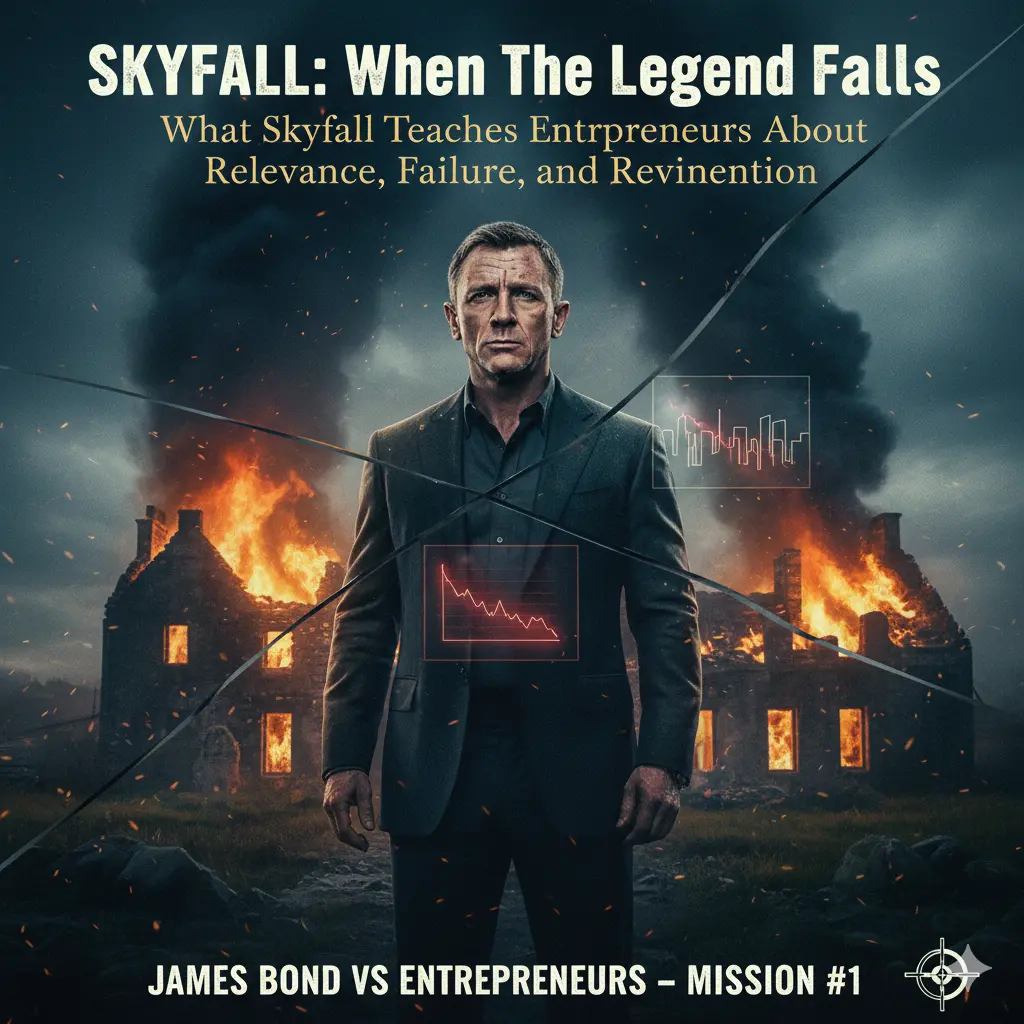
Table of Contents
- The Opening Shot: Death of an Icon
- Why Skyfall Hits Founders Differently
- The Entrepreneur’s Worst Nightmare: Becoming “Old News”
- Failing the Tests That Once Defined You
- Act One: The Fall
- Act Two: The Mirror
- Act Three: Return to Skyfall
- The $1.1 Billion Question
- Your Mission: The Skyfall Framework
- Final Transmission
- Upcoming Missions
- About This Series
The Opening Shot: Death of an Icon
Istanbul. A train rooftop. James Bond is shot.
He falls.
The camera follows his descent—tumbling through the air, crashing through structures, plummeting into dark water. The screen cuts to black. Adele’s voice rises: “This is the end.”
For 2 minutes and 43 seconds, we believe it.
This is the same moment every founder eventually hits — when the story everyone believed about you suddenly stops working.
And here’s what makes this opening revolutionary: For the first time in 50 years of Bond films, we watch the hero die. Not “almost die.” Not “fake his death strategically.” He fails the mission. Gets shot by his own agent. Falls into oblivion.
The legend is dead.
This is where your entrepreneurial journey really begins.
Not with the TechCrunch article. Not with the funding announcement. Not with the confident LinkedIn post about your launch.
It begins when you fall.
When the pitch deck that took you three months gets rejected in eight minutes. When your co-founder quits. When you check your bank account and realize you have 47 days of runway left. When the “next big thing” you’ve been building for two years gets released by a competitor with better funding, better marketing, and a better team.
When you fall, and the screen cuts to black.
Skyfall isn’t a Bond film. It’s a documentary about what happens after the fall.
Why Skyfall Hits Founders Differently
Skyfall is often described as Bond’s darkest film. But that’s not accurate.
It’s his most honest.
This is the only Bond movie where the enemy isn’t just external. The real antagonist is irrelevance.
For entrepreneurs, Skyfall feels uncomfortable because it mirrors the exact phase no founder wants to admit they’re in:
- The market has moved
- Your instincts feel slower
- The rules you mastered no longer apply
- People quietly wonder if you’re still the right person to lead
Skyfall isn’t about saving the world. It’s about proving — to yourself first — that you still belong in it.
— pause —
Let that sink in for a moment.
This isn’t about external validation. This is about the internal battle every founder faces when the ground shifts beneath them.
The Entrepreneur’s Worst Nightmare: Becoming “Old News”
Early in the film, Bond is declared dead.
Not ceremonially. Not heroically.
Administratively.
His obituary is written because the system has already moved on.
Founders experience this too — just without the headlines.
It happens when:
- Investors stop calling
- Customers choose newer alternatives
- Your past wins stop carrying weight
- Younger founders speak a language you no longer fully understand
You’re not failing loudly. You’re being quietly replaced.
That’s scarier.
Because loud failure at least gets attention. Quiet irrelevance means nobody even notices you’re gone.
Failing the Tests That Once Defined You
Bond fails every evaluation:
- Physical strength
- Accuracy
- Psychological resilience
These were once his superpowers.
Entrepreneurs face the same moment:
- Your growth playbook stops working
- Your intuition misfires
- Your confidence erodes because proof disappears
This is the most dangerous phase — not because you’re weak, but because your identity was built on past competence.
You’re not the person who built the first version anymore. The skills that got you from 0 to 1 won’t get you from 1 to 10. And you’re stuck in this terrible middle ground where you’re too experienced to start over, but not adapted enough to keep scaling.
Skyfall asks a brutal question:
Who are you when your metrics collapse?
Act One: The Fall
Scene 1: You Are Obsolete
Bond returns from the dead (as legends do), but he returns broken.
M welcomes him back, but the organization doesn’t. Gareth Mallory, the incoming chairman, looks at him with barely concealed doubt. The new Q—young, brilliant, dismissive—sizes him up like a museum piece.
“Age is no guarantee of efficiency,” Mallory says.
“And youth is no guarantee of innovation,” Bond replies.
But here’s the thing: Bond doesn’t believe his own words yet. Because when he takes the physical evaluation tests, he fails. The psychological assessment? Failed. The marksmanship test? Failed.
M lies about the results. She marks him as “passed” and sends him back into the field anyway.
Every entrepreneur knows this moment.
The market tells you your product is obsolete before it even launches. The newer, younger founders with their AI-powered, blockchain-integrated, venture-backed solutions make your approach look quaint. Legacy. Analog.
You’re building in a space where the average founder is 24. You’re 35. Or 42. Or 51.
You’re using proven methods while everyone else is “disrupting.” You’re talking about fundamentals while they’re talking about “10x growth hacks.”
And quietly, privately, in the 3 AM darkness of your own mind, you wonder: Am I too late? Is my time over?
But here’s what Skyfall teaches us that most startup narratives don’t:
The question isn’t whether you’re obsolete. The question is whether you’ll fight to prove you’re not—or whether you’ll accept the narrative and quit.
M doesn’t send Bond back because he passed the tests. She sends him back because she believes he’s still Bond, even when the metrics say otherwise.
Who is your M? Who believes in you when the numbers don’t?
Scene 2: Failing Every Test
The field mission in Shanghai is brutal in its efficiency.
Bond tracks an assassin to a glass skyscraper. The scene is visually stunning—neon reflections, silhouettes against illuminated windows, Roger Deakins’ cinematography at its peak. But narratively? Bond is struggling.
He’s slower. Less precise. The assassin escapes key intel before Bond can extract it. The mission is compromised.
Then Macau. The casino. Sévérine, the tragic Bond girl who’s more prisoner than partner. Bond promises to protect her.
He fails.
Silva kills her in front of him, turning her murder into a sadistic game of marksmanship. Bond takes the shot. Misses. She dies.
“Waste of good scotch,” Silva mocks.
This is the part of the founder journey nobody posts on LinkedIn.
The product launch that gets 11 signups instead of 1,100. The keynote speech where your demo crashes. The investor meeting where you blank on your own projections. The hire you were certain about who quits after three weeks.
The promise you made to your early believers—the ones who trusted you when you had nothing but a pitch deck and a dream—that you’d build something revolutionary.
And you’re failing them.
Not because you’re not working hard. Not because you don’t care. But because the old version of you isn’t enough for this mission anymore.
The skills that got you here won’t get you there. The confidence that carried you through the early days has been replaced by impostor syndrome. Every small failure compounds into evidence of a larger truth you’re terrified to admit:
Maybe I’m not good enough for this.
— pause —
Scene 3: The Weight of Expectation
Here’s where Skyfall does something extraordinary: it makes M the emotional center of the film.
Judi Dench’s M—cold, calculating, unflinching—has always been the authority figure. The boss. The one who sends agents to their deaths with bureaucratic efficiency.
But in Skyfall, we see her under siege.
A Parliamentary inquiry questions her judgment. Mallory suggests she retire with dignity. Silva’s cyberattacks expose her past decisions. Her authority is crumbling.
And yet, she refuses to quit.
“I’ll leave when the job’s done.”
For founders, M represents something crucial: the weight of responsibility when everything’s falling apart.
You’re not just fighting for yourself. You’re fighting for:
- The team who left stable jobs to join your startup
- The investors who believed in you when you had no traction
- The early customers who took a chance on an unproven product
- The family members who’ve watched you sacrifice everything
When you fail, you don’t fail alone. You fail for them.
And the guilt is suffocating.
M carries the weight of every agent she’s sent into danger. Every decision that got someone killed. Every compromise she made in service of “the mission.”
When Bond asks why she lied about his evaluation results, she doesn’t apologize. She says: “I needed you.”
Not “I believed in you.”
Not “I knew you’d bounce back.”
“I needed you.”
Raw honesty: Sometimes the people who believe in you aren’t betting on your recovery. They’re betting on your necessity.
Your investors don’t keep funding you because they think you’ve figured it out. They fund you because pivoting to a new founder would be more expensive than letting you figure it out.
Your co-founder doesn’t stay because they have confidence. They stay because leaving now would mean admitting the last two years were a waste.
Your customers don’t stick around because your product is perfect. They stick around because switching costs are too high.
You are needed, even when you’re broken.
The question is: What will you do with that burden?
Act Two: The Mirror
Silva: Your Inner Saboteur
Javier Bardem’s Silva is one of the greatest Bond villains precisely because he’s not interested in world domination or stolen weapons or global terrorism.
He wants revenge on M.
Silva was M’s agent once. Her favorite. The golden child who did the impossible missions with style and precision. But when a mission went sideways, M made a choice: trade Silva to the Chinese to save six other agents.
Silva was tortured. Abandoned. Left to rot.
When he tried to kill himself with a cyanide capsule, it didn’t work. It just destroyed his face, leaving him deformed beneath a prosthetic facade.
“Mommy was very bad,” he whispers, removing the prosthetic to reveal the horror beneath.
Silva is what happens when your origin story becomes your prison.
Every founder has an origin wound:
- The job that laid you off
- The industry that told you weren’t qualified
- The investor who dismissed you
- The market that ignored your first three attempts
- The mentor who betrayed your trust
That wound is what drives you. It’s why you’re building. It’s the fuel for your 80-hour weeks and your refusal to quit when logic says you should.
But here’s the trap: If you’re not careful, that wound becomes your identity.
Silva can’t move on. He’s spent years building his revenge plot with meticulous precision. He’s brilliant—hacking MI6, orchestrating Bond’s return, engineering his own capture as part of the plan. Every move calculated.
But all of it is in service of one thing: making M suffer.
He’s not building toward something. He’s destroying in response to something.
Ask yourself:
Are you building a company—or are you settling a score?
Are you creating value—or are you proving someone wrong?
Are you driven by mission—or by vendetta?
Because if your “why” is revenge, you’ll never be satisfied, even if you win.
Silva’s plan succeeds. He confronts M. He gets his moment. And it’s empty. Hollow. A deformed man screaming at his mother figure while his world burns around him.
The wound that drove him became the thing that destroyed him.
Mommy Was Very Bad
Let’s talk about the M-Silva-Bond triangle, because it’s the emotional core of the film.
Both Silva and Bond are M’s “sons.”
Both were orphans. Both were shaped by her decisions. Both devoted their lives to the service. Both were betrayed—Silva explicitly, Bond through years of being sent into danger with clinical detachment.
The difference?
Silva let the betrayal define him. Bond let it refine him.
When Bond finally confronts M about her lies, her manipulations, her willingness to sacrifice him for the mission, he doesn’t rage. He doesn’t plot revenge.
He asks one quiet question: “Why didn’t you call?”
When he was “dead.” When he was hiding in some beach shack, drinking himself numb, watching the world move on without him.
Why didn’t you call?
M’s answer is devastating in its honesty: “Because I knew you’d come back. You always do.”
This is the conversation every founder needs to have with their “M”—whoever that is for you.
The mentor who pushed you too hard.
The investor who doubted you at a crucial moment.
The co-founder who made decisions without you.
The parent who never understood why you’d risk everything on “this startup thing.”
They hurt you. Maybe not intentionally. Maybe not maliciously. But they did.
And you have two choices:
Become Silva — Let that hurt fuel a vendetta. Build something just to prove them wrong. Succeed out of spite. Except spite is a terrible long-term strategy, because winning doesn’t heal the wound. You’ll just move the goalposts and find a new enemy.
Become Bond — Acknowledge the hurt. Carry it. Let it make you more empathetic, more human, more real. And then choose to keep going anyway, not because you’re trying to prove anything, but because the mission still matters.
Skyfall asks: Can you be betrayed and still choose loyalty? Can you be broken and still choose to serve?
Because that’s what separates entrepreneurs who build legacies from those who just settle scores.
The Ex-Favorite Son
There’s a scene that doesn’t get talked about enough.
Silva and Bond, face to face. Silva circles Bond, touching his shoulders, his face. Taunting him.
“We’re the same, you and I. Her two sons. Her favorites. But she betrayed us both.”
And he’s right.
Both were shaped by M’s cold pragmatism. Both were used as tools. Both were expendable when the mission required it.
The only difference: Silva took it personally. Bond accepted it as the job.
In entrepreneurship, this distinction is everything.
The market will betray you. The pitch that worked last quarter won’t work this quarter. The strategy that built your first $1M won’t get you to $10M. The team structure that worked at 10 employees will collapse at 50.
You can rage at the market for changing. Or you can adapt.
You can blame VCs for not understanding your vision. Or you can learn to communicate it better.
You can resent customers for not seeing your product’s value. Or you can build better onboarding.
The market doesn’t owe you success. Investors don’t owe you funding. Customers don’t owe you their attention.
Silva expected loyalty from a world that promised none. Bond expected nothing—and built everything.
Act Three: Return to Skyfall
Sometimes The Old Ways Are Best
When Silva’s final assault comes, Bond makes an unexpected choice.
He doesn’t call in MI6’s tech. He doesn’t use Q’s gadgets. He doesn’t rely on the organization’s resources.
He takes M to his childhood home: Skyfall Manor in the Scottish Highlands.
A crumbling estate. Isolated. No backup. No advanced weapons. No satellite support.
Just Bond, an aging gamekeeper named Kincade, hunting rifles, and improvised explosives.
“Sometimes the old ways are the best.”
This is the moment every entrepreneur faces: when all the fancy tools fail, and you’re left with fundamentals.
When your growth hacks stop working.
When your paid ads become too expensive.
When your venture backing runs out.
When your “disruption” gets disrupted.
You strip it all away and go back to basics.
For Bond, that means:
- Hand-to-hand combat instead of gadgets
- Strategy over technology
- Trust in a handful of people instead of a massive organization
- Fighting on terrain he controls, not Silva’s digital battlefield
For founders, it means:
- Talking to customers instead of analyzing dashboards
- Solving real problems instead of chasing trends
- Building something people need instead of something VCs want to fund
- Surviving instead of scaling
Skyfall Manor is your MVP. Your origin. The scrappy, resourceful version of you before the venture funding and the Medium articles and the “thought leadership.”
Home Is Where Your Scars Live
The manor is decaying. Empty. Filled with ghosts.
Bond walks through it with a mixture of nostalgia and pain. Kincade, the gamekeeper who raised him after his parents died, is still there—old, weathered, but sharp.
“Some men are coming to kill us. We’re going to kill them first.”
Kincade doesn’t ask why. Doesn’t question the insanity. Just starts preparing.
This is your origin story—the place you came from, the wound that started everything.
For some founders, it’s literal: going back to the garage, the dorm room, the coffee shop where you wrote the first lines of code.
For others, it’s emotional: reconnecting with the problem you originally set out to solve before feature creep and investor pressure and market forces pulled you off course.
The question Skyfall asks is brutal: Are you willing to burn down everything you’ve built to remember who you are?
Because that’s what happens. Silva’s assault destroys the manor. It burns. The childhood home, the history, the ghosts—all of it goes up in flames.
And Bond survives.
Not because he saved Skyfall. But because he was willing to let it burn.
Founders obsess over preservation:
- Preserving runway
- Preserving team morale
- Preserving the original vision
- Preserving equity
- Preserving reputation
But sometimes, survival means letting it burn.
The product you spent two years building that nobody wants? Burn it.
The co-founder relationship that’s toxic but “we’ve been through so much”? Burn it.
The business model that worked in 2019 but is dying in 2025? Burn it.
The identity of being a “founder of X” when X is clearly failing? Burn it.
Skyfall teaches us: You are not the manor. You are Bond. The manor is just where you came from.
When it burns, you walk out of the ashes. Because the mission isn’t to preserve the past. It’s to survive into the future.
The Final Stand
The climax is visceral, brutal, and small.
No satellite weapons. No CGI explosions. No army of reinforcements.
Just Bond, M, and Kincade versus Silva and his mercenaries. In a burning manor. With dwindling ammunition.
They fight like cornered animals. Because that’s what they are.
Silva gets his wish: he corners M. Puts a gun in her hand and his head next to hers.
“We can die together.”
M is already dying—hit by Silva’s men, bleeding out. She knows she won’t survive this.
And Bond? Bond throws a knife across the room. It embeds in Silva’s back.
“Last rat standing.”
Silva dies. M dies. The manor is destroyed.
Bond is the only one left.
This is the part where I tell you the truth about entrepreneurship that nobody wants to say out loud:
Not everyone makes it to the other side.
Some startups die. Some founders burn out. Some relationships don’t survive the pressure. Some dreams, no matter how beautiful, don’t come true.
M’s death is the film acknowledging this. She gave everything to the service. She made impossible choices. She carried the weight of empires.
And she still dies. In a burned-out chapel. Holding Bond’s hand. Knowing she couldn’t save everyone.
But here’s what matters:
She doesn’t die defeated. She dies having fought. Having made the choice to stand her ground rather than retreat with dignity.
“I fucked this up, didn’t I?” she whispers to Bond.
“No,” he says. “You did your job.”
For founders, this is the hardest truth:
You can do everything right and still lose. You can work 100-hour weeks and still fail. You can be brilliant, resilient, strategic—and the market won’t care.
Success is not guaranteed by effort. Or intelligence. Or even by doing everything “right.”
But the mission is still worth it.
Not because you’ll definitely win. But because the fight itself is what defines you.
M dies. But she dies having shaped Bond into who he needed to become. She dies having protected something larger than herself.
When your startup fails—if it fails—the question isn’t “did you succeed?” The question is “did you become who you needed to become in the process?”
The $1.1 Billion Question
Skyfall made $1.108 billion worldwide. The highest-grossing Bond film of all time.
Not Casino Royale, which rebooted the franchise.
Not Spectre, which had a bigger budget.
Not No Time to Die, which had the emotional weight of Craig’s final film.
Skyfall.
The one where Bond fails. The one where he’s broken. The one where the villain wins (Silva gets to M). The one where the hero’s childhood home burns to the ground.
Why?
Because audiences didn’t want invincibility. They wanted humanity.
The same reason founders follow other founders — not companies.
For 50 years, Bond was a fantasy. A man who could seduce anyone, defeat anyone, survive anything. He was aspirational, yes. But he wasn’t real.
Skyfall made him real.
It showed us the scars. The doubt. The failure. The moments when even legends question whether they’re still relevant.
And we connected with that more than we ever connected with perfection.
This is the lesson Silicon Valley keeps forgetting:
Founders project invincibility. They post about “crushing it” and “10x growth” and “excited to announce.” They share the wins, hide the losses, and perpetuate the myth that success is linear.
But the founders we actually respect—the ones we follow, the ones whose journeys we care about—are the ones who show us the falls.
Not the sanitized “we pivoted and learned so much” LinkedIn posts. The real falls.
- The founder who shares their actual financial runway: 37 days left
- The CEO who admits they don’t know what to do next
- The entrepreneur who says “I’m scared I’m failing my team”
Vulnerability isn’t weakness. It’s your competitive advantage.
Because in a world of polished pitches and manufactured success stories, the truth is rare. And rare things are valuable.
Your Mission: The Skyfall Framework
Enough philosophy. Let’s get tactical.
If you’re reading this and you’re in your own Skyfall moment—when everything’s falling apart and you’re questioning whether you still have what it takes—here’s your framework:
Phase 1: Acknowledge The Fall
Don’t pretend you’re fine.
Bond doesn’t return from the dead and immediately become 007 again. He’s slow, he’s unsure, he fails the tests. He acknowledges he’s not the same.
Action Step: Write down, specifically, where you’re failing right now. Not “things are tough.” Specifics:
- Our MRR is down 23% from last quarter
- I haven’t talked to a customer in 6 weeks
- My co-founder and I haven’t had a real conversation in 3 months
- I’m spending 4 hours a day on Twitter instead of building
Honesty is the first step to recovery.
Phase 2: Find Your M
Who believes in you when the metrics don’t?
M lies about Bond’s test results because she believes he’s still capable, even when the data says otherwise.
Action Step: Identify 1-3 people who will tell you the truth and believe in your potential. Not cheerleaders. Not yes-men. People who will say:
- “You’re struggling, but you can figure this out”
- “This specific thing needs to change, and I’ll help you change it”
- “I still believe in you, even when you don’t believe in yourself”
Then: actually talk to them. Be vulnerable. Ask for help.
Phase 3: Identify Your Silva
What wound is driving you—and is it helping or hurting?
Silva’s origin wound (betrayal by M) drives everything he does. It makes him brilliant, but it also destroys him.
Action Step: Complete these sentences:
- I started this company because…
- The person/company/experience I’m trying to prove wrong is…
- If I’m brutally honest, I’m building this to…
Then ask: Is this motivation sustainable? Or is it just revenge in disguise?
If your “why” is healthy (solving a problem, creating value, building something meaningful), protect it.
If your “why” is toxic (proving someone wrong, settling a score, ego), acknowledge it—and then choose a better reason to keep going.
Phase 4: Return To Your Skyfall
What were you good at before all the noise?
Bond strips away the tech, the organization, the gadgets. He goes back to fundamentals: strategy, instinct, resourcefulness.
Action Step: Ask yourself:
- What did I do in the early days that actually worked?
- What skills got me here that I’ve stopped using?
- If I had to rebuild this company with $0 and just myself, what would I focus on first?
Then: do that thing. Even if it doesn’t scale. Even if it’s not “fundable.” Even if other founders would laugh at how unglamorous it is.
Phase 5: Be Willing To Let It Burn
What are you holding onto that needs to die?
Skyfall Manor burns. The past burns. Bond’s childhood home burns. And he survives because he lets it burn.
Action Step: Brutally honest audit:
- What product/feature are you building that nobody wants?
- What partnership is dragging you down?
- What process is broken but “we’ve always done it this way”?
- What version of yourself is no longer serving the mission?
Choose one thing. Kill it. This week.
Not “deprioritize.” Not “put on the backlog.” Kill it.
Phase 6: Redefine The Mission
At the end of Skyfall, M is dead. The manor is destroyed. Bond is alone.
But he’s still 007.
The mission doesn’t end because you lost something. The mission evolves.
Action Step: Write a new mission statement. Not for the company. For you.
- Why am I still doing this?
- What matters more than success?
- Who am I becoming through this struggle?
- If I fail, what will I have learned that makes the failure worth it?
This becomes your North Star when everything else is chaos.
Final Transmission
Here’s what Skyfall teaches us that no business book will:
The fall is not the end of your story. It’s the beginning of the real one.
The story where you’re not invincible. Where you fail tests. Where people doubt you. Where you have to strip away everything you thought made you special and rediscover who you are at your core.
That’s the story worth telling.
Not the hockey-stick growth curve. Not the funding announcement. Not the exit.
The fall. The doubt. The moment when you thought it was over—and you decided to keep going anyway.
Because here’s the truth they don’t tell you in startup accelerators:
Most founders will fail. Most startups will die. Most dreams will fall short.
But the ones who survive aren’t the ones who never fell. They’re the ones who fell—and got back up. Who burned their Skyfall Manor and walked out of the ashes. Who looked at the rubble of everything they built and said: “Okay. What’s next?”
Bond stands in the ruins of Skyfall Manor. M is dead. The past is burned. Everything has changed.
Mallory—now the new M—hands him a file. A new mission.
“So, 007… are you ready to get back to work?”
Bond looks at the file. Looks at Mallory. And smiles.
“With pleasure, M. With pleasure.”
The mission never ends. It just evolves.
You are not your failures. You are not your startup. You are not the manor.
You are Bond. The last rat standing. The one who survives because you refuse to quit, even when quitting would be easier.
Welcome to Skyfall.
Now get back to work.
Upcoming Missions
- Mission #2: Casino Royale — Conviction Before Validation
- Mission #3: No Time To Die — Letting Go as a Leader
- Mission #4: GoldenEye — Adapting When Your World Changes Overnight
- Mission #5: Licence to Kill — When It Gets Personal
If you’re in your Skyfall moment right now — save this. You’ll need it again.
Questions? Reflections? Your own Skyfall moment?
Drop a comment. Let’s talk about the falls that shaped us.
And if this resonated, share it with another founder who needs to hear it.
Because the mission is better when we’re not alone.
[Subscribe to get the next mission delivered to your inbox]
[Follow me on LinkedIn for the series]
[Share this with a founder who’s falling]
About This Series
James Bond vs Entrepreneurs explores entrepreneurship, founder mindset, leadership under pressure, startup failure, and reinvention through the lens of 60+ years of Bond films. Each mission decodes what founders can learn from Bond’s journey—from failure and resilience to strategy and evolution.
This is Mission #1: Skyfall.
The mission continues.
💬 Join the Conversation