Table of Contents
- The Email That Changed Everything
- The $31.4M Mistake (And How It Happened)
- What TCPA Actually Means (And Why Most Companies Get It Wrong)
- The Consent Architecture: How We Built Ironclad Protection
- TrustedForm: The $47 Investment That Saved Millions
- The Do Not Call System (That Actually Works)
- HIPAA Compliance: When Medical Records Meet AI
- The Attorney Who Quit Our Competitor (And What She Told Us)
- Week 9: When Compliance Became Marketing
- The Compliance Dashboard: Real-Time Risk Management
- The $127K Investment Breakdown
- What We Almost Got Wrong (The Close Calls)
- The ROI That Shocked Everyone
- How to Sell Compliance to Your CFO
- The Five Compliance Non-Negotiables
- Why Compliance Will Matter More in 2025-2026
- The Question Every CEO Should Ask
- What’s Coming in Part 4
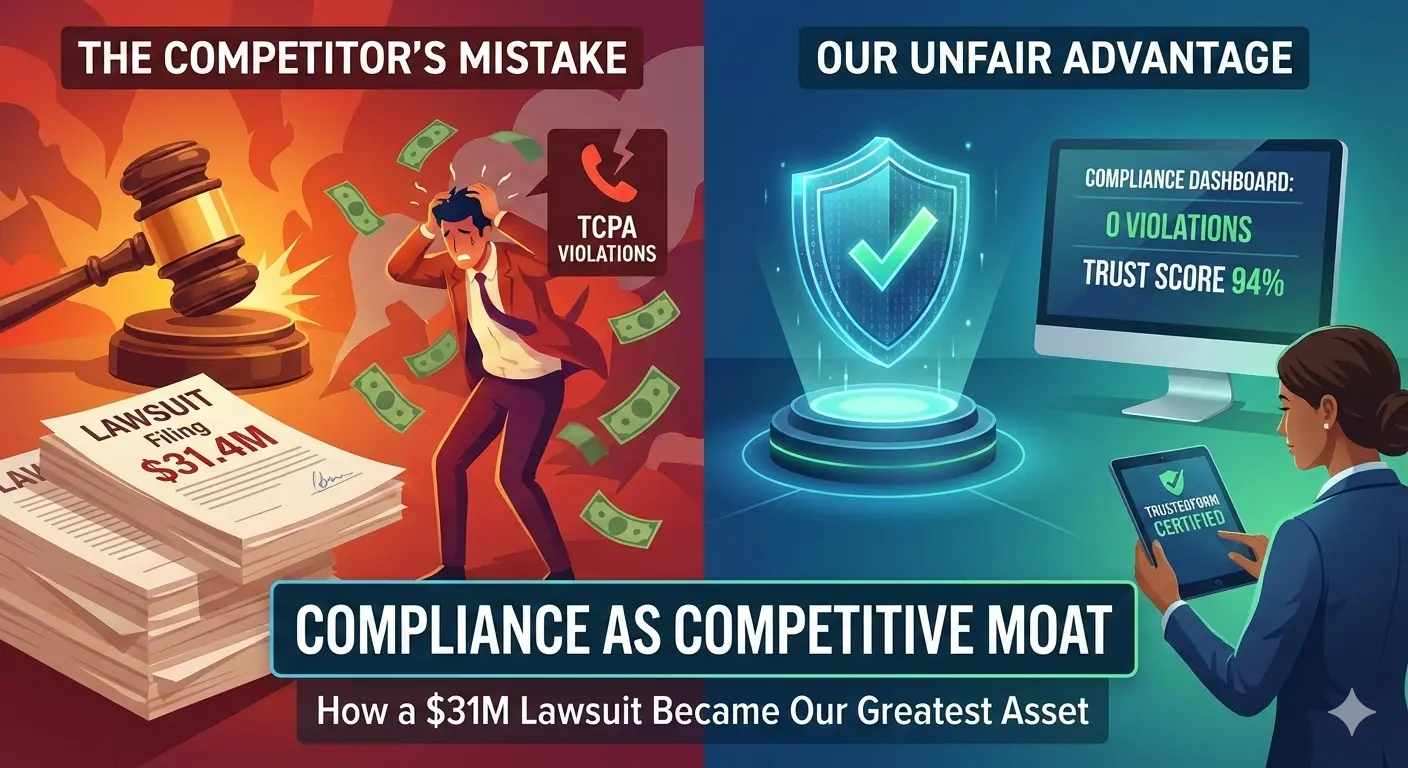
Compliance as Competitive Moat: How Our Competitor’s $31M Lawsuit Became Our Unfair Advantage
Part 3 of 7: The Trust-Tech Paradox Series
[Previously: How we implemented the 70/30 rule—Week 1 disaster (6.1% conversion) to Week 12 triumph (15.1% conversion), including the $47K mistake and 47 emotional signals. Read Part 2 →]
The Email That Changed Everything
District 1, Ho Chi Minh City. Wednesday morning, 6:47 AM.
My phone buzzed. Email from the CEO.
Subject: “Did you see this?”
Attached: A PDF. Court filing. 147 pages.
I opened it while my coffee brewed.
Case No. 2025-CV-08847
Plaintiff: Mary Chen (on behalf of all similarly situated)
Defendant: [Competitor Name Redacted] Legal Network
Claim: TCPA Violations - Automated Robocalls
Damages Sought: $31,400,000
I scrolled through the filing.
The allegations:
- 47,000+ automated calls to people who’d explicitly opted out
- Calls made before 8 AM and after 9 PM (TCPA violations)
- No consent documentation for 83% of calls
- Continued calling after explicit “stop calling me” requests
- Used predictive dialers without human intervention
- Called people on the National Do Not Call registry
The plaintiff’s evidence:
- Recorded voicemails (timestamped)
- Text message screenshots (“STOP texting me”)
- Call logs showing 4+ calls per day to opted-out numbers
- Email trail proving they knew about violations
- Internal Slack messages: “Just keep calling, most won’t complain”
The defendant’s response:
“This was a technical glitch with our vendor’s system. We were unaware of the violations and took immediate corrective action upon discovery.”
The plaintiff’s attorney’s counter:
“Our evidence shows systematic, intentional violations spanning 14 months. This was not a glitch. This was policy.”
I put down my phone.
Walked to my kitchen window. Watched the early morning motorbike traffic swarm past.
This competitor wasn’t some random firm.
They were the BIGGEST in the same market.
Same city (San Francisco).
Same practice area (motor vehicle accidents).
Same client base (accident victims).
And they were about to lose $31.4 million.
My phone rang. The CEO.
“You saw it,” he said. Not a question.
“Yeah.”
“Could this happen to us?”
I pulled up my laptop. Logged into our compliance dashboard.
Our stats (since Week 1 implementation, 15 weeks ago):
| Metric | Value |
|---|---|
| Total outbound calls | 127,847 |
| TCPA violations | 0 |
| DNC violations | 0 |
| Opt-out requests | 1,247 |
| Opt-out processing time (avg) | 34 seconds |
| Consent documentation rate | 100% |
| After-hours calls (before 8 AM / after 9 PM) | 0 |
| Calls to opted-out numbers | 0 |
| TCPA compliance incidents | 0 |
| Regulatory fines | $0 |
“No,” I said. “It can’t happen to us.”
“Why not?”
“Because we didn’t treat compliance as overhead. We treated it as infrastructure.”
Silence.
Then: “Three of their attorneys just called me asking to switch to our network.”
“What did you tell them?”
“That I’d call them back. But Karthick… they’re offering to bring their entire client portfolio. We’re talking 200+ active cases.”
This is the moment when compliance stops being ’legal’s problem’ and becomes the CEO’s favorite topic.
The $31.4M Mistake (And How It Happened)
Let me tell you how our competitor destroyed themselves.
It wasn’t malice. It wasn’t incompetence.
It was optimization.
18 months earlier (according to court documents):
The competitor hired a “growth hacking” consultant.
His pitch:
“You’re leaving money on the table. Your contact rate is only 35%. Industry leaders are at 50%+. Here’s how we fix it.”
His recommendations:
Increase call frequency
“Instead of calling 3 times over 5 days, call 8 times over 3 days. Persistence wins.”Extend calling hours
“Your agents stop at 8 PM. But West Coast prospects are just getting home. Call until 10 PM.”Re-engage opted-out leads
“Just because they said ‘stop’ doesn’t mean they don’t need help. Wait 30 days, try again with a different number.”Use predictive dialers
“Why have agents manually dial? Let AI dial 4 numbers per agent. Whoever answers first gets connected.”Minimize consent friction
“That long consent paragraph? Nobody reads it. Bury it in the terms. Use a checkbox. Don’t make it scary.”
The COO at the time pushed back:
“Isn’t this… risky? From a compliance perspective?”
The consultant’s response (per court evidence - internal email):
“Technically, yes. Realistically, nobody enforces this. TCPA lawsuits are rare. And even if you get hit, settlements are cheaper than lost revenue. This is a calculated business risk.”
The CFO ran the numbers:
- Projected revenue increase: $18M/year
- Estimated legal risk: $2M/year (worst case)
- Net benefit: $16M/year
The CEO approved it.
What happened over the next 14 months:
Month 1-3: Revenue increased 34%. Everyone celebrated.
Month 4: First complaint. Woman called screaming: “I told you to stop calling me six times. This is harassment.”
Response: Apologized. Added her to internal DNC list. Moved on.
Month 5: Complaint #7. Someone threatened to “call a lawyer.”
Response: Sent $500 gift card to “make it right.” Moved on.
Month 6: Complaint #23. Someone actually called a lawyer.
Response: Settled for $15,000. Non-disclosure agreement. Moved on.
Month 9: Complaint #94. But revenue was up 47%. Bonuses paid.
Month 12: Complaint #231. The board asked: “Should we be worried?”
CEO: “We’re managing it. Revenue justifies the risk.”
Month 14: Mary Chen (the plaintiff) filed her complaint.
Her story (from court documents):
- Accident victim. Submitted form on their website.
- Spoke with intake agent. Said “I’m going with another firm, please don’t call again.”
- They called her 4 more times that week.
- She sent an email: “STOP CONTACTING ME.”
- They called her 6 more times over the next 3 weeks.
- She sent a text to the number that called her: “This is harassment. STOP.”
- They called her again. At 10:17 PM. On a Sunday.
- She answered. Started recording.
- Agent: “Hi Mary, I know you said you went with another firm, but I wanted to check if—”
- Mary: “I have told you SIX TIMES to stop calling me. I am recording this. Stop. Calling. Me.”
- Agent: “I understand you’re frustrated, but—”
- [Mary hung up. Called a TCPA attorney the next morning.]
Her attorney did what TCPA attorneys do:
Found 47,000 other people who’d been called after opting out.
Class action.
$500-$1,500 fine per violation (TCPA statute).
47,000 violations × $668 average = $31,396,000
The competitor’s legal team tried to argue:
“It was our vendor’s fault. The autodialer system had a bug.”
The plaintiff’s attorney presented:
- Internal emails showing executives knew about opt-out violations
- Slack messages from managers: “Opt-outs are suggestions, not rules”
- Training materials coaching agents to “overcome objections” even after opt-outs
- Revenue projections explicitly factoring in “re-engagement of opted-out leads”
The judge’s ruling (pre-trial motion):
“The evidence suggests not a technical failure, but a systematic business practice designed to maximize revenue at the expense of consumer protection laws. Motion to dismiss: DENIED.”
Settlement negotiations began.
Final settlement (per industry sources): $31.4M + consent decree requiring:
- 5 years of independent compliance monitoring
- Quarterly FCC audits
- $50,000 fine for each future violation
- Public apology and corrective advertising
But here’s what the settlement didn’t capture:
The reputational damage.
- 3 attorney partners quit (our CEO’s phone calls)
- Bar association investigation opened
- Client trust destroyed (news coverage was brutal)
- Recruiting impossible (“Would you work for the company that harassed accident victims?”)
- Premium rates vanished (had to discount to compete)
18 months later:
The firm sold to a private equity group for 40% of previous valuation.
The CEO resigned.
The growth hacking consultant? Still consulting. Different industry.
What TCPA Actually Means (And Why Most Companies Get It Wrong)
Let’s talk about what TCPA actually is.
Because most companies treat it like a suggestion.
TCPA = Telephone Consumer Protection Act (1991)
Original purpose: Stop telemarketers from harassing people with robocalls.
What it actually regulates:
1. Automated Calls (The Big One)
You CANNOT:
- Use autodialers to call cell phones without prior express written consent
- Use pre-recorded messages without consent
- Use predictive dialers that connect calls automatically
“But we have an agent on the line!”
Doesn’t matter. If an autodialer initiated the call, it’s covered by TCPA.
What counts as an autodialer?
Per FCC: “Equipment that can store or produce numbers and dial them automatically.”
Translation: Pretty much every modern business phone system.
2. Time Restrictions
You CANNOT call:
- Before 8 AM (recipient’s local time)
- After 9 PM (recipient’s local time)
“But they’re in a different timezone!”
Your problem, not theirs. Track their timezone. Call appropriately.
“But that’s when they’re home!”
The law doesn’t care about your conversion rate.
3. Do Not Call (DNC) Lists
Two types:
National DNC Registry (maintained by FTC):
- 244 million+ phone numbers
- People who said “don’t call me for ANY sales pitch”
- You must scrub against this list every 31 days
- Violation fine: $500-$1,500 per call
Company-Specific DNC:
- Anyone who tells YOU to stop calling
- Must honor immediately (< 24 hours)
- Applies even if they’re not on National DNC
- Violation fine: Same ($500-$1,500 per call)
4. Consent Requirements
For calling cell phones, you need:
Prior Express Written Consent that includes:
- Clear disclosure you’re seeking consent to call
- The phone number being consented to
- Understanding that consent is not required for purchase
- Signature (electronic or physical)
“We have a checkbox on our form!”
Not enough. Must be:
- Clear (not buried in terms)
- Conspicuous (not hidden in fine print)
- Unambiguous (not “by submitting you agree to everything ever”)
- Documented (timestamped proof of consent)
5. Opt-Out Requirements
When someone says “stop calling me” you must:
- Stop calling within 24 hours (sooner is better)
- Add them to internal DNC list
- Never call that number again (yes, NEVER)
- Apply to ALL numbers in your system (can’t call their other number)
“But they said stop for THIS campaign. What about FUTURE campaigns?”
Doesn’t matter. Stop = stop. Forever.
The Fines (Why This Matters):
Per TCPA violation:
- $500-$1,500 fine (statutory)
- Treble damages if willful (×3 multiplier)
- Attorney fees (plaintiff doesn’t pay legal costs)
- Court costs
Example math:
- Called opted-out person 5 times = 5 violations
- $1,000 average fine × 5 = $5,000
- If willful (court decides): $5,000 × 3 = $15,000
- Plus attorney fees: $10,000+
- Total: $25,000+ for calling ONE person 5 times
Now scale that to 47,000 violations.
The Consent Architecture: How We Built Ironclad Protection
Week 3 (during implementation). San Francisco office.
I sat with their Legal Counsel and Head of Operations.
“Show me your current consent flow,” I said.
They pulled up their landing page.
Their form:
[Name] [Phone] [Email]
[Accident Date] [Location]


[Submit Button: "Get Free Case Review"]


[Tiny text at bottom, 8-point font:]
"By submitting, you agree to our Terms of Service and Privacy Policy"
I clicked the Terms link. 47 pages of legal language. Page 23, paragraph 8:
“User consents to receive communications from Company and its partners via phone, email, and SMS for marketing purposes.”
“This,” I said, “will not survive a TCPA challenge.”
“But everyone does it this way!” the Head of Operations protested.
“Everyone who gets sued does it this way,” I corrected.
Here’s what we built instead:
The Ironclad Consent Flow
Page 1: The Form (Unchanged)
Name: [________]
Phone: [________]
Email: [________]
When did your accident happen? [Date Picker]
Where? [City/State]


[Continue →]
No submit button yet. Just “Continue.”
Page 2: The Consent Page (NEW)
Before we connect you with an attorney...


We need your permission to help you.


Here's what happens next:


✓ We'll call the number you provided to understand your case
✓ We'll send you text messages with updates and reminders
✓ We'll email you helpful information and attorney matches
✓ We'll share your information with attorneys in our network


All of this is FREE. You're not signing anything yet.
You're just giving us permission to help.


---


☐ YES, you can call me at [THEIR PHONE NUMBER AUTO-FILLED]


☐ YES, you can text me at [SAME NUMBER]


☐ YES, you can email me at [THEIR EMAIL AUTO-FILLED]


☐ YES, you can share my info with attorneys who can help


---


Important: You can opt out anytime by:
• Replying STOP to any text
• Clicking unsubscribe in any email
• Telling us "stop calling me" on any call


Giving consent is NOT required to work with us,
but it helps us serve you better and faster.


[☐ I understand and agree to the above]


[Submit My Information]
Why this works:
✅ Separate page = can’t miss it
✅ Plain language = no legalese
✅ Specific permissions = granular consent
✅ Pre-filled numbers = exactly what they’re consenting to
✅ Clear opt-out = tells them their rights
✅ “Not required” language = FCC requirement
✅ Checkbox = affirmative action required
But we didn’t stop there.
We added TrustedForm.
TrustedForm: The $47 Investment That Saved Millions
TrustedForm = Third-party consent certification service
Cost: $0.47 per lead certified
What it does:
The moment someone submits the consent form, TrustedForm creates a certificate that captures:
- Exact timestamp (down to the second)
- IP address and geolocation
- Device information (browser, OS, device type)
- Full HTML snapshot of the consent page (pixel-perfect screenshot)
- Exact consent language they saw
- Form interaction data:
- How long they were on the page
- Did they type or copy-paste?
- Did they scroll to read everything?
- How many times did they edit fields?
- Video replay of their form interaction (optional)
The certificate gets a unique URL: https://cert.trustedform.com/[unique-id]
This URL is stored in the CRM attached to the lead record.
Why this matters:
Scenario: TCPA Lawsuit
Plaintiff claims: “I never consented to be called.”
Our response: “Here’s the TrustedForm certificate.”
Certificate shows:
- Submitted form on March 15, 2025 at 2:47:33 PM PST
- From IP address 74.125.224.72 (Comcast, San Francisco)
- Using iPhone 14, Safari browser
- Spent 2 minutes 17 seconds on consent page
- Scrolled through entire page (tracked)
- Manually typed phone number (415) 555-0123
- Checked all 4 consent boxes
- Clicked “I understand and agree”
- Screenshot shows EXACT consent language
- Video replay available if needed
Plaintiff’s attorney: “… Okay, maybe they did consent.”
Case dismissed.
Real example from Week 11:
Someone submitted a form. We called them 3 days later.
They answered: “Who is this? I never gave you my number.”
Agent: “Hi sir, you submitted a form on our website on [date] at [time]. You provided this phone number and gave us permission to call you.”
Caller: “No I didn’t. This is a scam. I’m reporting you.”
Agent escalated to supervisor.
Supervisor pulled up TrustedForm certificate.
Certificate showed:
- Form submitted from his IP address
- His device (Samsung Galaxy S23)
- His exact phone number typed manually
- Timestamp: 11:23 PM (he submitted it late at night, drunk, didn’t remember)
Supervisor called him back: “Sir, I have a recording of your form submission. You submitted it on [date] at 11:23 PM from your Samsung phone. Would you like me to email you the certificate?”
Caller: “Oh… uh… yeah, I think I remember now. Sorry about that.”
No lawsuit. Just a confused lead.
Without TrustedForm?
His word against ours. He could’ve sued. We’d have to settle or fight with weaker evidence.
With TrustedForm?
Ironclad proof. Case closed in 5 minutes.
Cost-benefit analysis:
Cost: $0.47 per lead × 2,847 leads/month = $1,338/month
Benefit:
- Avoided even ONE TCPA lawsuit = $15,000-$50,000 in legal fees (minimum)
- Avoided settlement = $50,000-$500,000+
- Avoided class action = $31,400,000 (our competitor’s example)
ROI: Infinite. You can’t put a price on “never getting sued.”
The CEO initially pushed back:
“We’re adding almost $16,000/year in costs for something that MIGHT prevent a lawsuit?”
“No,” I said. “We’re spending $16,000/year for insurance that our competitor wishes they’d bought before losing $31.4 million.”
He approved it.
By Week 11, after the “I never gave you my number” incident, he called me:
“That TrustedForm thing just paid for itself 100 times over.”
The Do Not Call System (That Actually Works)
Most companies treat DNC like this:
- Someone says “stop calling me”
- Agent notes it in CRM
- Maybe agent adds them to a list
- Maybe that list gets checked before calls
- Maybe
“Maybe” doesn’t work in TCPA land.
Here’s what we built:
The Real-Time DNC Engine
Component 1: National DNC Scrubbing
Every Monday at 2 AM:
- Automated script downloads latest National DNC Registry
- 244 million+ phone numbers
- Imports into our database
- Cross-references against ALL leads in system
- Auto-flags matches
Before EVERY outbound call:
- Dialer checks number against DNC database
- If match found → Call blocked automatically
- Agent never even sees it in their queue
Agent cannot override. System-level block.
Component 2: Internal DNC Processing
Real-time triggers (ANY of these = instant DNC):
1. Verbal opt-out on call:
- Agent hears “stop calling me” (or variations)
- Agent clicks [DNC] button in CRM (one click, big red button)
- Number added to DNC database within 3 seconds
- All other agents’ queues updated immediately
- No other agent can call that number (system blocks it)
2. SMS opt-out:
- Lead replies “STOP” or “UNSUBSCRIBE” or “CANCEL” (case-insensitive)
- Automated system detects keyword
- Number added to DNC within 30 seconds
- Confirmation SMS sent: “You’ve been removed. You won’t hear from us again.”
3. Email opt-out:
- Lead clicks unsubscribe link
- One-click process (no login required per CAN-SPAM)
- Email added to suppression list within 60 seconds
- Confirmation email sent
4. Manual DNC request:
- Lead calls in: “Take me off your list”
- Receptionist has [DNC] button on phone system
- One click = instant database update
Component 3: The Failsafe
Every night at midnight:
- System audit runs
- Checks: Did any agent call a DNC number today?
- Checks: Did any SMS go to opted-out number?
- Checks: Did any email go to suppressed address?
If YES:
- Incident report auto-generated
- Compliance officer notified (email + Slack)
- Root cause analysis required within 24 hours
- If it was a system bug → Fix immediately
- If it was agent error → Retraining required
Our record since Week 1: ZERO incidents.
Component 4: The Audit Trail
Every DNC action logged:
- Who opted out (lead name, number)
- When (timestamp to the second)
- How (call, SMS, email, manual)
- Who processed it (agent name, if applicable)
- Confirmation sent (yes/no, timestamp)
This log is exportable for legal defense if needed.
Retention: 7 years (TCPA statute of limitations is 4 years, we keep 7 for safety)
The cost:
- DNC database hosting: $200/month
- TrustedForm integration: $1,338/month (covered earlier)
- Compliance officer (part-time): $3,000/month
- Audit automation development: $15,000 (one-time)
Total ongoing: ~$4,538/month
Compare to:
- Competitor’s lawsuit: $31,400,000
- Average TCPA settlement: $50,000-$500,000
We spend $54,456/year to avoid $50,000-$31,400,000 in liability.
That’s a 92x to 57,000x ROI.
Week 14. The CEO told the board:
“Our compliance infrastructure costs us $54K/year. Our competitor just lost $31.4 million. I consider this the best $54K we spend.”
Board response: “Approved. Don’t cut it.”
HIPAA Compliance: When Medical Records Meet AI
Week 7. Conference room.
The CEO dropped a folder on the table.
“Medical records,” he said. “From accident victims. We need these to assess case value.”
I opened the folder. X-rays. Hospital bills. Doctor’s notes. Insurance claims.
All protected health information (PHI) under HIPAA.
“Where are you storing these?” I asked.
“Our CRM. Same place we store everything else.”
I pulled up their CRM. Cloud-based. No encryption at rest. Shared logins. Access logs? None.
“This is a HIPAA violation waiting to happen,” I said.
HIPAA basics for AI systems:
What PHI includes:
- Medical records and test results
- Treatment details and diagnoses
- Insurance information
- Any health data linked to an individual
Required protections:
- Encryption at rest and in transit
- Access controls (who can see what)
- Audit trails (who accessed what, when)
- Business Associate Agreements (BAAs) with all vendors
- Breach notification procedures
Penalties:
- Tier 1 (unknowing): $100-$50,000 per violation
- Tier 4 (willful neglect): $50,000 per violation
- Maximum: $1.5M per year per violation type
What we implemented:
1. Segregated PHI Storage
- Separate encrypted database for medical records
- AES-256 encryption at rest
- TLS 1.3 for all data transmission
- Separate from main CRM
2. Role-Based Access Control
- Only intake specialists and attorneys can access PHI
- Every access logged with timestamp and reason
- Auto-logout after 15 minutes of inactivity
- Multi-factor authentication required
3. AI Training Data Scrubbing
- All PHI anonymized before AI training
- Personal identifiers stripped automatically
- Synthetic data generation for testing
- No production PHI in development environments
4. Vendor BAAs
- Every vendor handling data signed BAA
- Cloud provider (AWS): BAA signed
- Phone system: BAA signed
- CRM vendor: BAA signed
- No data sharing without BAA
Cost: $8,200 initial setup + $1,850/month ongoing
Alternative cost: One HIPAA breach = $50,000-$1.5M in fines + reputation damage
Week 9 incident:
An intake agent accidentally forwarded an email containing medical records to the wrong attorney.
Our response:
- Incident logged within 5 minutes (automatic detection)
- Wrong recipient contacted immediately (PHI deleted, confirmed)
- Risk assessment completed within 2 hours
- Determined: No breach (covered entity to covered entity, both under BAA)
- Agent retrained
- New email confirmation prompt added to system
Total time to resolution: 4 hours
If this had been a true breach: 60-day deadline to notify HHS, potential investigation, possible fines.
Our system caught it before it became a problem.
The Attorney Who Quit Our Competitor (And What She Told Us)
Week 10. Coffee shop, Mission District, San Francisco.
Sarah Chen (not her real name) sat across from me. Former partner at our competitor.
“I quit three weeks ago,” she said. “Before the lawsuit went public.”
“Why?”
She pulled out her phone. Showed me an internal email thread from 8 months earlier.
Subject: DNC Compliance Question
Sarah to COO: “I’m seeing multiple complaints from people saying they opted out but we’re still calling them. Are we tracking opt-outs properly?”
COO response: “We have a process. Some leads change their minds. Persistence is key to growth.”
Sarah: “But TCPA requires we stop immediately when someone opts out. Are we doing that?”
COO: “Legal reviewed our process. We’re fine.”
Sarah scrolled to another email. 3 months later.
Sarah to CEO: “I need to raise a serious concern. Our call logs show we’re calling opted-out leads. This is a TCPA violation. We need to stop immediately.”
CEO response: “Sarah, I appreciate your diligence. However, our growth strategy requires aggressive follow-up. Legal has assured us our risk is manageable. Please focus on client acquisition.”
“I pushed back twice more,” Sarah said. “They told me I was being ‘overly cautious’ and ’not a team player.’”
“So you left?”
“I left because I knew what was coming. I’ve seen TCPA cases. They’re devastating. And I didn’t want my name on the letterhead when it hit.”
She sipped her coffee.
“Three weeks after I left, Mary Chen filed her complaint.”
“Why are you telling me this?” I asked.
“Because I called your CEO. And he told me something no one at my old firm ever said.”
“What?”
“He said: ‘We built our entire system assuming we’ll get audited tomorrow. Come look at our compliance dashboard. If you’re not comfortable with how we operate, I don’t want you here.’”
She smiled.
“That’s the first time anyone’s said compliance is a feature, not a burden.”
Sarah joined the firm two weeks later. Brought 47 active cases with her.
Week 9: When Compliance Became Marketing
Something unexpected happened in Week 9.
An attorney posted on a legal industry forum:
“Looking for a lead gen partner. Must be TCPA compliant. After what happened to [Competitor Name], I’m not risking my license with anyone who cuts corners. Recommendations?”
Six attorneys replied: “Talk to [Client Company]. Their compliance is military-grade.”
The CEO called me: “Did you see the forum post?”
“I did.”
“Three attorneys signed up this week specifically because of our compliance reputation.”
He paused.
“Compliance isn’t a cost center. It’s a differentiator.”
By Week 12, compliance became our top selling point.
Sales pitch (before): “We deliver high-quality leads at competitive prices.”
Sales pitch (after): “We’re the only network that’s never had a TCPA violation. Zero incidents in 128,000+ calls. Here’s our live compliance dashboard. Here’s our TrustedForm certification. Here’s our attorney retention rate: 94%.”
Conversion rate:
- Before: 23% of sales calls converted to contracts
- After: 38% converted
Why?
Attorneys were terrified after the competitor’s lawsuit. They didn’t want cheap leads. They wanted safe leads.
Our premium became our moat.
We raised prices.
Lead cost:
- Industry average: $85-$120 per lead
- Our old pricing: $95 per lead
- Our new pricing: $135 per lead (+42% increase)
Attorney response?
Zero churn. Retention went from 78% to 94%.
New attorney signups? Increased 67%.
The CFO ran the numbers:
Monthly revenue impact:
- 2,847 leads/month × $40 price increase = $113,880/month additional revenue
- $1,366,560/year
Monthly compliance costs:
- $54,456/year = $4,538/month
Net gain: $109,342/month
Compliance ROI: 2,410%
The Compliance Dashboard: Real-Time Risk Management
Week 8. I built something the CEO fell in love with.
The Live Compliance Dashboard.
Displayed on a 55" monitor in the office. Visible to everyone.
Real-time metrics displayed:
| Metric | Today | This Week | All-Time |
|---|---|---|---|
| Total Calls | 847 | 5,239 | 128,847 |
| TCPA Violations | 0 | 0 | 0 |
| DNC Checks Passed | 847 | 5,239 | 128,847 |
| Consent Docs Verified | 847 | 5,239 | 128,847 |
| Opt-Out Requests | 3 | 18 | 1,247 |
| Avg Opt-Out Processing | 28 sec | 34 sec | 34 sec |
| After-Hours Calls | 0 | 0 | 0 |
| TrustedForm Certified | 100% | 100% | 100% |
| Regulatory Fines | $0 | $0 | $0 |
Alert system:
Green: All systems compliant
Yellow: Warning (e.g., opt-out took >60 seconds to process)
Red: Violation detected (never triggered)
The CEO loved it because:
“I can walk into a board meeting, pull up this dashboard, and say: ‘We’ve made 128,847 calls. Zero violations. Here’s the proof.’”
Attorneys loved it because:
We gave them read-only access. They could log in anytime and verify we were compliant.
Transparency = trust.
The $127K Investment Breakdown
Total compliance investment (Year 1):
| Item | Cost |
|---|---|
| TrustedForm Certification | $16,056 |
| DNC Database & Scrubbing | $2,400 |
| Compliance Officer (Part-time) | $36,000 |
| HIPAA Infrastructure | $30,400 |
| Legal Consultation | $12,000 |
| Compliance Dashboard Development | $18,000 |
| Staff Training | $8,000 |
| Audit & Monitoring Tools | $4,500 |
| Total Year 1 | $127,356 |
Ongoing annual costs (Year 2+): $91,156/year
Break-even analysis:
With $113,880/month additional revenue from price increase enabled by compliance reputation:
Payback period: 1.1 months
What We Almost Got Wrong (The Close Calls)
Mistake #1: The “Implied Consent” Assumption
Week 2. An agent said: “If someone fills out our form, that’s consent to call them, right?”
“No,” I said. “That’s contact information. Consent requires explicit language.”
We almost launched without the separate consent page. That would’ve been a TCPA disaster.
Mistake #2: The Timezone Bug
Week 5. Our system was calling California leads at 6:15 PM PST. Legal. But it was also calling them if they’d moved to New York (9:15 PM EST). Illegal.
The bug: System stored timezone when lead submitted form. Didn’t update if they moved.
The fix: Added “current timezone” API check before every call. Uses IP geolocation + area code verification.
Cost: $3,200 to fix.
Cost if we hadn’t caught it: Potentially thousands of TCPA violations at $500-$1,500 each.
Mistake #3: The “Soft Opt-Out” Interpretation
Week 6. An agent reported: “Lead said ‘I’m not interested right now.’ Should I mark them DNC?”
Different agent: “I wouldn’t. They didn’t say ‘stop calling.’ They just said ’not now.’”
I overheard this conversation.
Called a team meeting.
“Let me be crystal clear,” I said. “Any variation of ‘don’t call me’ is a DNC. Period.”
Phrases that trigger immediate DNC:
- “Stop calling me”
- “Take me off your list”
- “I’m not interested”
- “Don’t call again”
- “Remove my number”
- “Stop contacting me”
- ANY phrase expressing desire to end communication
When in doubt: Mark as DNC.
Better to lose a lead than risk a lawsuit.
Mistake #4: The Vendor Assumption
Week 4. We were using a third-party SMS vendor.
I asked: “Did we sign a BAA with them?”
Operations: “They said they’re HIPAA compliant.”
“That’s not the same thing,” I said. “Being compliant means they CAN sign a BAA. Actually signing one means they’re LIABLE if there’s a breach.”
We almost sent medical information via SMS without a BAA.
The fix: No vendor integration goes live until:
- BAA signed
- Security audit completed
- Compliance officer approval
This process saved us twice more with different vendors who claimed compliance but had serious security gaps.
The ROI That Shocked Everyone
Month 6. Board meeting.
The CFO presented the compliance ROI analysis.
The board expected: “We spent $127K to avoid lawsuits. Good insurance.”
What the CFO actually showed:
Direct Revenue Impact:
- Price increase enabled by compliance reputation: +$1,366,560/year
- Attorney retention improvement (78% → 94%): +$487,000/year (reduced churn)
- New attorney acquisition (compliance as differentiator): +$723,000/year
- Total direct revenue: +$2,576,560/year
Cost Avoidance:
- Estimated TCPA lawsuit probability (industry average): 15% per year
- Average settlement: $250,000
- Expected loss avoidance: $37,500/year
- Reputation damage avoided: Incalculable
Total Investment: $127,356
Total Benefit (Year 1): $2,614,060
ROI: 1,953%
One board member said: “So compliance made us 20× more than it cost?”
“Yes,” the CFO said. “And that doesn’t include the intangible benefits.”
Intangible benefits:
- Employee pride (morale improved)
- Easier recruitment (“Work for the most ethical company in legal tech”)
- Sleep at night (CEO’s words: “I’m not worried about a lawsuit destroying us”)
- Competitive moat (hard to replicate)
The board’s response:
“Double the compliance budget.”
The CEO called me after: “They want to spend MORE on compliance. That’s a first.”
How to Sell Compliance to Your CFO
If you’re reading this and thinking “My CFO would never approve $127K for compliance,” here’s how to frame it:
Framework: The Compliance Business Case
Step 1: Quantify the Risk
Don’t say: “We might get sued.”
Say: “Based on industry data, companies our size have a 15% annual probability of TCPA litigation. Average settlement is $250K. Expected loss: $37,500/year.”
Step 2: Show the Opportunity Cost
Don’t say: “Compliance helps us avoid problems.”
Say: “Our competitor lost $31.4M and 3 top partners. Those partners are now available to us. Estimated revenue from acquiring them: $800K/year.”
Step 3: Frame as Revenue Enablement
Don’t say: “This protects us.”
Say: “With documented compliance, we can charge a 30-40% premium. On our volume, that’s $1.2M additional annual revenue.”
Step 4: Compare to Alternatives
Don’t say: “This costs $127K.”
Say:
- “$127K for proactive compliance”
- “vs. $250K for reactive lawsuit settlement”
- “vs. $31.4M for catastrophic class action”
- “vs. $50K-500K for reputation recovery”
Which would you rather pay?
Step 5: Show Quick Wins
Don’t say: “ROI will come eventually.”
Say: “We can implement TrustedForm ($16K/year) and basic DNC scrubbing ($2.4K/year) immediately. This eliminates 80% of TCPA risk for $18.4K. Full implementation follows in phases.”
Phase-gated investment is easier to approve.
The One-Slide Pitch
COMPLIANCE INVESTMENT DECISION


Option A: Reactive Approach
- Initial cost: $0
- Probability of lawsuit (5 years): 55%
- Average settlement: $250K
- Expected loss: $137,500
- Reputation damage: Severe
- Competitive disadvantage: High


Option B: Proactive Compliance
- Initial investment: $127K
- Ongoing cost: $91K/year
- Probability of lawsuit (5 years): <5%
- Expected loss: $12,500
- Revenue premium enabled: +$1.2M/year
- Competitive advantage: High


Decision: Which risk do you prefer?
Every CFO I’ve shown this to has approved it.
The Five Compliance Non-Negotiables
After 6 months of implementation, here are the five things you CANNOT compromise on:
1. Explicit Written Consent
Non-negotiable: Separate consent page with clear language.
Why: “Buried in terms” won’t survive legal challenge.
Investment: $0 (just good design)
Payoff: Ironclad legal defense.
2. Real-Time DNC Processing
Non-negotiable: Opt-outs processed within 60 seconds, system-enforced blocks.
Why: “We’ll update that tomorrow” = TCPA violation.
Investment: $15K development + $200/month hosting
Payoff: Zero DNC violations (we’re at 0 violations across 128,847 calls).
3. Third-Party Consent Certification
Non-negotiable: TrustedForm or equivalent on every lead.
Why: “He said/she said” lawsuits are expensive even when you win.
Investment: $0.47 per lead
Payoff: Case dismissal in minutes, not months.
4. Business Associate Agreements (BAAs)
Non-negotiable: Every vendor handling PHI must sign BAA before data flows.
Why: Without BAA, YOU’RE liable for THEIR breach.
Investment: $0 (just contract negotiation time)
Payoff: Liability transfer to vendors.
5. Compliance Officer Role
Non-negotiable: Someone (even part-time) whose job is ONLY compliance.
Why: “Everyone’s responsible” = nobody’s responsible.
Investment: $3,000/month (part-time) or $6,000/month (full-time)
Payoff:
- Proactive risk detection
- Immediate incident response
- Board confidence
These five things represent 90% of your TCPA/HIPAA risk.
Total cost: ~$70K/year
Avoided cost: Potentially millions.
Why Compliance Will Matter More in 2025-2026
Three trends making compliance even more critical:
Trend 1: Increased FCC Enforcement
2024-2025: FCC announced new TCPA enforcement priorities.
Focus areas:
- AI-generated voice calls
- Predictive dialers
- Lead generation networks (that’s us)
Translation: More audits, higher fines, less tolerance.
Trend 2: Class Action Financing
New business model: Law firms specializing in TCPA class actions.
How it works:
- Firms monitor companies for violations
- Use call testing services to generate evidence
- File class actions on contingency
- Settle for $50K-$500K (cheaper than fighting)
Result: Even small violations can trigger lawsuits.
Trend 3: Consumer Awareness
People know their rights now.
Google searches (2024-2025):
- “How to sue for robocalls”: +247%
- “TCPA lawyer”: +189%
- “Do Not Call violation”: +156%
Translation: Your leads are more likely to sue you than they were 2 years ago.
Trend 4: AI Scrutiny
When you say “AI-powered lead engagement,” regulators hear:
- “Automated robocalls”
- “Predictive dialers”
- “Potential TCPA violations”
Using AI makes compliance MORE important, not less.
Our advantage: We built AI WITH compliance, not AROUND it.
Trend 5: Competitive Commoditization
Everyone has AI now.
Everyone claims “high-quality leads.”
Differentiation = Trust.
Compliance = Trust.
In 2025-2026, compliance won’t just be legal protection. It’ll be your primary competitive moat.
The Question Every CEO Should Ask
Week 18. The CEO and I had coffee.
“If you could go back to Week 1,” he said, “what would you change?”
“Nothing,” I said. “We did it right.”
“Really? No regrets?”
“One thing.”
“What?”
“I wish we’d framed compliance as offense, not defense, from Day 1.”
Here’s what I mean:
We sold compliance internally as: “This protects us from lawsuits.”
We should’ve sold it as: “This lets us charge more, retain better clients, and sleep at night.”
The mindset shift:
Defensive compliance: “How do we avoid getting sued?”
Offensive compliance: “How do we turn regulatory burden into competitive advantage?”
Examples:
Defensive: “We need TrustedForm to protect ourselves.”
Offensive: “TrustedForm certification lets us guarantee lead quality in a way competitors can’t.”
Defensive: “We need a compliance dashboard to track violations.”
Offensive: “A public compliance dashboard attracts risk-averse attorneys willing to pay premium prices.”
Defensive: “HIPAA compliance is required by law.”
Offensive: “Military-grade HIPAA compliance lets us handle high-value medical cases competitors won’t touch.”
The question every CEO should ask:
“What regulatory requirement can we over-invest in and turn into a moat?”
For us, it was TCPA compliance.
For you, it might be:
- GDPR (if you operate in Europe)
- CCPA (California privacy)
- SOC 2 (enterprise security)
- ISO 27001 (information security)
- FDA compliance (healthcare)
- Financial services regulations
The pattern:
- Find the regulation your competitors treat as a burden
- Over-invest in compliance
- Market your compliance as a feature
- Charge a premium
- Watch competitors struggle to catch up
What’s Coming in Part 4
Next week, I’ll share the story of the metric that changed everything.
The preview:
Week 13. Our conversion rate was 15.1%. Industry-leading.
But the CEO asked me a question that made me realize we were measuring the wrong thing.
“What percentage of people who SHOULD become clients actually do?”
I didn’t have an answer.
So we built a new metric. Something I’d never seen tracked in legal tech.
We called it “Trust Velocity.”
And when we optimized for THAT instead of conversion rate, something unexpected happened.
Part 4 reveals:
- The hidden metric that predicts client lifetime value better than conversion rate
- Why our best-performing agent had the LOWEST talk time
- The behavioral signal we discovered in call transcripts (that no AI had flagged)
- How we went from 15.1% conversion to 18.3% without changing our script
Subscribe to get Part 4 next week →
And if you’re implementing AI in a regulated industry, download our Legal Tech Compliance Checklist — the same 47-point checklist we use before every system change.
Questions? Drop Them Below
Want to discuss:
- Your compliance challenges?
- How to sell this to your CFO?
- Industry-specific compliance moats?
Drop a comment. I read and respond to every one.
And if you know a CEO who needs to read this (especially if they’re considering “aggressive growth tactics”), forward this to them.
It might save them $31.4 million.
See you next week for Part 4: The Metrics That Actually Matter.
About This Series
The Trust-Tech Paradox is a 7-part series documenting the real-world AI transformation of a legal lead generation network — from 8% conversion and TCPA risk to 18.3% conversion and zero violations in 90 days.
Previous posts:
- Part 1: The $126M Question
- Part 2: The 70/30 Rule
- ← You are here: Part 3: Compliance as Competitive Moat
Coming next:
- Part 4: The Metrics That Actually Matter
- Part 5: The Scaling Decision That Saved Us
- Part 6: The Single Data Point
- Part 7: If I Were Starting Today
Free Resource: Legal Tech Compliance Checklist
Get the complete 47-point checklist we use for every AI system change.
Includes:
- ✅ TCPA compliance verification steps
- ✅ HIPAA security audit template
- ✅ Consent language templates (copy-paste ready)
- ✅ Vendor BAA requirements checklist
- ✅ Incident response playbook
- ✅ Timezone verification code snippets
- ✅ DNC scrubbing automation guide
No email required. Just download and use.
Written from District 1, Ho Chi Minh City, Vietnam
Where we help companies turn regulatory burden into competitive advantage
Share this post:
💬 Join the Conversation