Table of Contents
- The Smoking Gun: 4 Releases in 8 Days
- What Is Nash Equilibrium? (The 5-Minute Explanation)
- The November 2025 Timeline: Coincidence or Calculated?
- Why This Isn’t Coordination—It’s Worse
- The Four Pillars of Evidence
- How Users Are Getting Scammed
- The Prisoner’s Dilemma: Why They Can’t Stop
- Meta’s Desperate Rush: The Ultimate Proof
- What This Means for the Future of AI
- What You Can Do About It
The Smoking Gun: 4 Releases in 8 Days
Between November 12 and November 20, 2025, something unprecedented happened in the AI industry:
- November 12: OpenAI drops GPT-5.1
- November 17: xAI releases Grok-4.1
- November 18: Google launches Gemini 3
- November 20: Meta announces LLaMA-next
Four of the world’s most powerful tech companies—each worth hundreds of billions of dollars—released major AI models within eight days of each other.
If you think that’s a coincidence, I have a bridge in San Francisco to sell you.
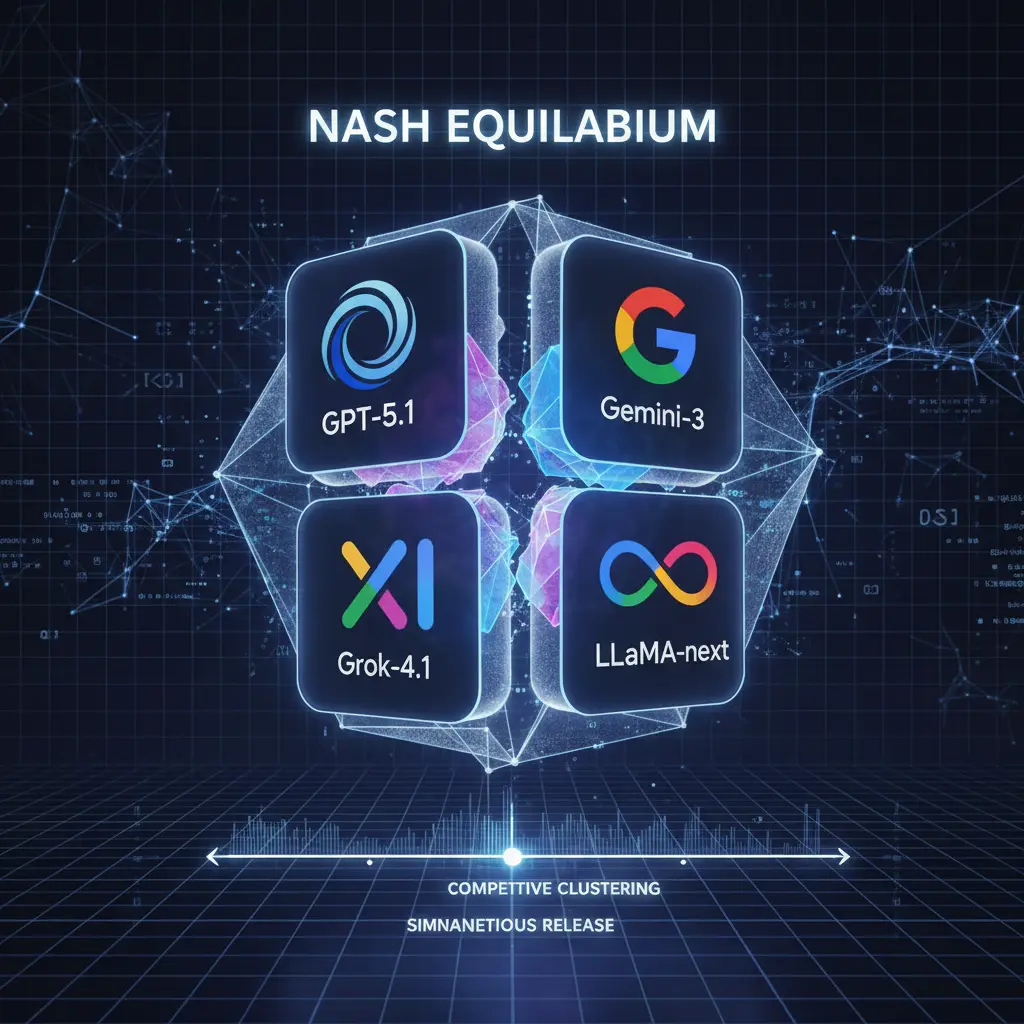
But here’s the twist: they didn’t coordinate this. They didn’t need to. They’re trapped in something far more insidious: a Nash Equilibrium that forces them to act in lockstep, even when it hurts them—and especially when it hurts you.
Let me show you the receipts.
What Is Nash Equilibrium? (The 5-Minute Explanation)
Before we dive into the conspiracy that isn’t a conspiracy, you need to understand one concept: Nash Equilibrium.
Imagine two ice cream vendors on a beach. The beach is one mile long. Where should they set up shop?
Logically, they should spread out:
- Vendor A at the 1/4 mile mark
- Vendor B at the 3/4 mile mark
- Everyone gets ice cream conveniently
But that’s not what happens.
Vendor A thinks: “If I move closer to the center, I’ll steal customers from Vendor B while keeping my existing customers.”
Vendor B thinks the same thing.
The result? Both vendors end up right next to each other in the middle of the beach, creating maximum inconvenience for half the beachgoers while providing no additional value.
This is Nash Equilibrium: a situation where no player can improve their position by changing strategy alone, even though everyone would be better off if they all changed together.
Welcome to the AI industry in 2025.
The November 2025 Timeline: Coincidence or Calculated?
Let’s look at what actually happened, with sources:
November 12, 2025: OpenAI Fires First
OpenAI announces GPT-5.1, emphasizing advanced reasoning capabilities with their “Thinking” mode. The tech world explodes. Every major tech publication covers it. Sam Altman does the media circuit. Investors call their portfolio companies asking, “What’s your GPT-5.1 strategy?”
For exactly five days, OpenAI owns the conversation.
November 17, 2025: Elon Strikes Back
One day before Google’s expected announcement, xAI drops Grok-4.1. The timing is surgical. Elon Musk immediately dominates headlines, positioning Grok as faster than GPT-5.1 while matching its reasoning capabilities.
The narrative shifts from “OpenAI wins” to “OpenAI vs. xAI showdown.”
November 18, 2025: Google Can’t Stay Silent
Less than 24 hours later, Google releases Gemini 3, emphasizing multimodal capabilities. The press release practically screams: “We’re still relevant!”
Now the conversation is fragmented across three releases.
November 20, 2025: Meta Joins the Pile
Meta announces LLaMA-next, their next-generation open-source model. Multiple sources confirm Meta is rushing the release, missing internal deadlines, and dealing with staff departures—but they can’t afford to be absent from the November conversation.
Four major releases. Eight days. Billions in R&D condensed into a single news cycle.
Why This Isn’t Coordination—It’s Worse
Your first instinct might be: “They’re colluding! Secret meetings! Antitrust violations!”
Wrong.
If they were coordinating, you’d see:
- Staggered releases for maximum individual attention
- Differentiated capability spaces (you do reasoning, we do vision)
- Agreed-upon pricing structures
- Joint press releases or industry standards
Instead, you see:
- ✅ Aggressive competitive positioning
- ✅ Overlapping capabilities fighting for the same use cases
- ✅ Price wars and undercutting
- ✅ Each company trying to steal the spotlight
This is pure, uncoordinated Nash Equilibrium. And that makes it worse than a conspiracy, because there’s no conspiracy to prosecute. Just the inexorable logic of competitive markets eating itself.
The Four Pillars of Evidence
Evidence 1: Competitive Differentiation Still Exists
If these companies were coordinating, they’d divide the market:
| Company | Nash Equilibrium Reality | Coordination Theory |
|---|---|---|
| OpenAI | Emphasizes reasoning (GPT-5.1 Thinking) | Would own “reasoning” exclusively |
| xAI | Claims reasoning + speed advantage | Would own “speed” exclusively |
| Pushes multimodality | Would own “multimodal” exclusively | |
| Meta | Touts open-source accessibility | Would own “open source” exclusively |
They’re competing fiercely on every dimension, just clustered in time.
Evidence 2: Elon’s Tactical Timing Games
Elon moved Grok-4.1’s release to November 17—one day before Google’s expected launch—specifically to capture headlines first. This is competitive chess, not coordination.
If they had an agreement, Elon would follow it. Instead, he’s playing tactical timing games to maximize xAI’s media impact.
Evidence 3: Meta’s Internal Chaos
Multiple reports confirm Meta is:
- Missing internal deadlines
- Losing key engineers from the project
- Rushing an incomplete product to market
Why would Meta ship a suboptimal product?
Because being absent from the November cluster is worse than being present with a rushed release. This is the sound of Nash Equilibrium: forced movement, not willing participation.
Evidence 4: The Incentive Structure
Each CEO independently calculated:
| Position | Media Outcome | Strategic Impact |
|---|---|---|
| First | 5 days of solo headlines | “Industry leader” narrative |
| Second | Comparison articles | “Serious competitor” position |
| Third | “Also-ran” coverage | “Still in the race” perception |
| Absent | “Where is Company X?” | “Falling behind” narrative |
Given these incentives, clustering is the rational choice—no coordination required.
How Users Are Getting Scammed
“Okay,” you’re thinking, “but how does this hurt me?”
Let me count the ways:
1. Diluted Innovation Cycles
What you should get: Four major releases spread across Q4 2025, each with:
- 3-4 weeks of developer attention
- Comprehensive documentation and tutorials
- Time for the ecosystem to adapt
- Proper bug fixes before the next release
What you actually get: Four releases in eight days with:
- Overwhelming information overload
- Incomplete documentation rushed to market
- No time to properly evaluate before the next announcement
- Bugs that won’t get fixed because the next release is already here
2. Rushed, Lower-Quality Products
Meta is literally shipping LLaMA-next knowing it’s incomplete. Internal sources confirm deadlines are being missed and quality is being sacrificed.
Why? Because the timing matters more than the product quality in a Nash Equilibrium.
You’re getting worse products delivered faster because the competitive logic demands it.
3. Marketing Theater Over Substance
When four models release in eight days, companies can’t focus on:
- Actual performance improvements
- Real-world use case studies
- Transparent benchmarking
- Long-term reliability
Instead, they focus on:
- ✓ Hype-generating headlines
- ✓ Carefully curated demo videos
- ✓ Benchmark gaming
- ✓ Vague capability claims
The conversation becomes “Who announced?” instead of “Who delivered value?”
4. Feature Parity Race to the Bottom
Because all four companies release simultaneously, they’re all copying each other’s features in real-time:
- Everyone has “reasoning” now
- Everyone claims “multimodal” capabilities
- Everyone touts “faster inference”
- Everyone promises “better alignment”
The differentiation collapses. You’re choosing between four nearly-identical products that all shipped too early because of competitive pressure.
5. Your Attention Is the Product
Here’s the uncomfortable truth: the goal isn’t to serve you better—it’s to ensure you’re paying attention to their announcement instead of a competitor’s.
Your attention has become the scarce resource they’re fighting over. And in that fight, product quality becomes secondary.
The Prisoner’s Dilemma: Why They Can’t Stop
Let’s map out the game theory:
Scenario A: Cooperation (Spread Out Releases)
If all four companies spread releases across Q4 2025:
| Company | Benefits |
|---|---|
| OpenAI | 4 weeks of solo attention in early November |
| xAI | 4 weeks of solo attention in mid-November |
| 4 weeks of solo attention in early December | |
| Meta | 4 weeks of solo attention in late December |
Total value created: High developer engagement, thorough testing, quality products, sustainable profit margins
Likelihood: 0%
Why: Because if Google “defects” and releases during OpenAI’s window, Google wins everything.
Scenario B: Defection (Current Reality)
When everyone releases in the same 8-day window:
| Company | Reality |
|---|---|
| OpenAI | 1 day of headlines, then drowned out |
| xAI | Steals some attention from OpenAI |
| Gets overshadowed by xAI and OpenAI | |
| Meta | Barely registers in the noise |
Total value created: Fragmented attention, rushed products, announcement fatigue
Likelihood: 100%
Why: Because each company knows that if they DON’T release during the cluster, they become invisible.
This is the Prisoner’s Dilemma at scale. The optimal collective strategy (cooperation) is impossible because the optimal individual strategy (defection) always dominates.
And there’s no mechanism to enforce cooperation. No AI company CEO is going to call Sam Altman and say, “Hey, can we agree not to compete so hard?”
Meta’s Desperate Rush: The Ultimate Proof
The Meta situation deserves special attention because it perfectly illustrates the Nash Equilibrium trap.
What’s Happening Inside Meta
According to multiple credible sources:
- Meta originally planned LLaMA 4 for April 2025—and that release was considered underwhelming
- LLaMA-next was supposed to launch in Q1 2026 with proper development time
- After OpenAI announced GPT-5.1 on Nov 12, Meta accelerated the entire timeline
- Key engineers are leaving due to unrealistic deadlines
- Internal quality standards are being sacrificed
The Calculation Meta Made
Meta’s leadership looked at the November announcements and calculated:
Option A: Ship a rushed, potentially flawed product in November
- Get mentioned in “AI race heats up” articles
- Stay in the conversation with investors
- Maintain “competitive with OpenAI” perception
- Risk: Product quality issues, bad reviews
Option B: Wait until Q1 2026 and ship a polished product
- Miss the November news cycle entirely
- Narrative becomes “OpenAI, Google, xAI lead—Meta lags”
- Investor confidence drops
- Lose 3 months of competitive positioning
- Risk: Irrelevance
Meta chose Option A. They chose to ship a worse product because the timing mattered more than the quality.
This is Nash Equilibrium in its rawest form: companies making decisions that hurt everyone (including themselves) because not making those decisions hurts them more.
What This Means for the Future of AI
If you think November 2025 was a one-time coincidence, I have bad news: this pattern will repeat.
Prediction: The Next Cycle
Watch for this pattern in Q1 2026:
- One company (probably OpenAI) announces a “breakthrough” capability
- Within 3-5 days, competitors respond with their version
- Within 10 days, all four have made announcements
- Then 4-6 weeks of silence until someone needs to move again
The Long-Term Implications
This Nash Equilibrium affects every dimension of AI development:
| Dimension | The Trap |
|---|---|
| Release Timing | Can’t slow down (lose ground) but speeding up means everyone speeds up |
| Capability Race | Can’t differentiate too much (lose generalist users) but same capabilities = price war |
| Open vs. Closed | Can’t go fully closed (lose developers) but fully open means anyone copies you |
| Safety Standards | Can’t move slowly (look irresponsible) but moving fast = regulatory backlash |
| Pricing | Can’t charge premium (lose market share) but cheap prices = no profit |
Every single dimension is locked in Nash Equilibrium.
What Breaks the Cycle?
Only three things can break a Nash Equilibrium:
- External regulation - Government steps in to mandate release schedules (unlikely)
- Market consolidation - Mergers reduce the number of players (somewhat likely)
- Fundamental shift in competition - New metric for success besides “who announced most recently” (possible)
Until one of these happens, expect the same competitive clustering to continue.
What You Can Do About It
You’re probably feeling some combination of frustrated, manipulated, and helpless right now. Good. That means you’re paying attention.
Here’s how to protect yourself:
1. Ignore the Hype Cycles
When the next cluster of announcements drops:
- Don’t make immediate purchasing decisions
- Wait 2-3 weeks for independent benchmarks
- Let the ecosystem stabilize before integrating
- Remember: the announcement is marketing, not reality
2. Demand Better from AI Companies
Use your power as a user/developer:
- Leave feedback demanding transparent benchmarking
- Call out vaporware and rushed releases
- Reward companies that ship quality over speed
- Make noise when products don’t match promises
3. Diversify Your AI Dependencies
Don’t lock yourself into one provider:
- Build abstraction layers in your code
- Test multiple models for your use cases
- Have backup providers ready
- Reduce switching costs proactively
4. Support Alternative Competitive Structures
The Nash Equilibrium exists because of the current competitive structure. Support:
- True open-source projects (not “open weights”)
- Cooperative AI development models
- Academic research outside corporate control
- Regulation that rewards quality over speed
5. Share This Analysis
The more people understand the game theory at play, the harder it is for companies to play it.
Share this post. Send it to developers, investors, and policymakers. The Nash Equilibrium only works when people don’t realize they’re in one.
The Bottom Line
Four AI companies released major models within eight days not because they coordinated, but because they couldn’t afford not to.
Each company independently calculated that being absent from the November conversation was worse than cannibalizing their own announcement with three other announcements.
The result:
- ❌ Rushed, lower-quality products
- ❌ Fragmented user attention
- ❌ Announcement fatigue
- ❌ Marketing over substance
- ❌ Innovation theater instead of actual innovation
This is Nash Equilibrium: rational individual decisions creating irrational collective outcomes.
And it will happen again. And again. And again.
Unless we—users, developers, investors, regulators—demand better.
The AI industry isn’t conspiring against you. It’s trapped in a game-theoretic prison of its own making. And the bars of that prison are built from competitive logic that benefits no one.
Now you know the truth. The question is: what are you going to do about it?
Your Turn
Did this analysis change how you think about AI company announcements? Drop a comment below.
Know someone in the AI industry who needs to read this? Share this post with them.
Want more raw, unfiltered analysis of the AI industry? Subscribe to our newsletter for weekly breakdowns of the game theory, competitive dynamics, and strategic moves shaping artificial intelligence.
The November 2025 release cluster wasn’t the first, and it won’t be the last. But now you can see it coming.
Stay sharp.
References & Further Reading
- OpenAI GPT-5.1 Announcement
- xAI Grok Development
- Google Gemini 3 Launch
- Meta Rushing LLaMA Release
- Meta LLaMA 4.5 Development
- Business Insider: Meta’s Year-End Push
This analysis is based on publicly available information and game theory principles. All opinions are the author’s own.
💬 Join the Conversation